

Your beard represents your personal style statement, but without proper cutting and shaping techniques, even the most impressive facial hair becomes an unruly mess. A professional-quality mens beard cut requires understanding the science behind hair growth patterns, mastering the right tools, and implementing systematic trimming strategies. Whether you're maintaining a short stubble or sculpting a full yeard, the cutting techniques you choose directly impact your beard's density, shape, and overall health.
Understanding Beard Growth Patterns Before Your First Cut
Problem: Most men approach their first mens beard cut without understanding how facial hair grows in different directions across the face. This leads to uneven cutting, patchy appearance, and frustrated attempts at styling.
The follicles on your jawline grow downward, whilst cheek hair angles toward your ears, and neck hair grows in multiple conflicting directions. Each facial zone contains hair with distinct growth cycles, thickness variations, and natural curl patterns. The anagen (growth) phase lasts 2-6 months for facial hair, producing different lengths across regions even when growth starts simultaneously.
Agitation: Cutting against these natural patterns creates resistance, pulls follicles, and produces jagged edges that fray within days. The sebaceous glands attached to each follicle produce oils that travel down the hair shaft, but improper cutting seals these pathways, causing dryness and brittleness. Your beard's natural architecture collapses when you ignore directional growth, resulting in a shape that fights your face rather than flattering it.
Mapping Your Unique Facial Hair Direction
Before touching trimmer to beard, spend three days observing how your facial hair naturally falls. After showering, let your beard air-dry without touching it. Photograph it from five angles: front, both profiles, and both three-quarter views. Mark the natural growth direction on printed photos using arrows.
This mapping reveals:
- Cowlicks where hair spirals from a central point
- Convergence zones where different growth directions meet
- Sparse patches requiring strategic cutting to minimize visibility
- Dense clusters needing thinning for balanced appearance
The knowledge transforms your cutting approach from guesswork to precision engineering. Understanding facial hair growth patterns provides the foundation for every subsequent trimming decision.
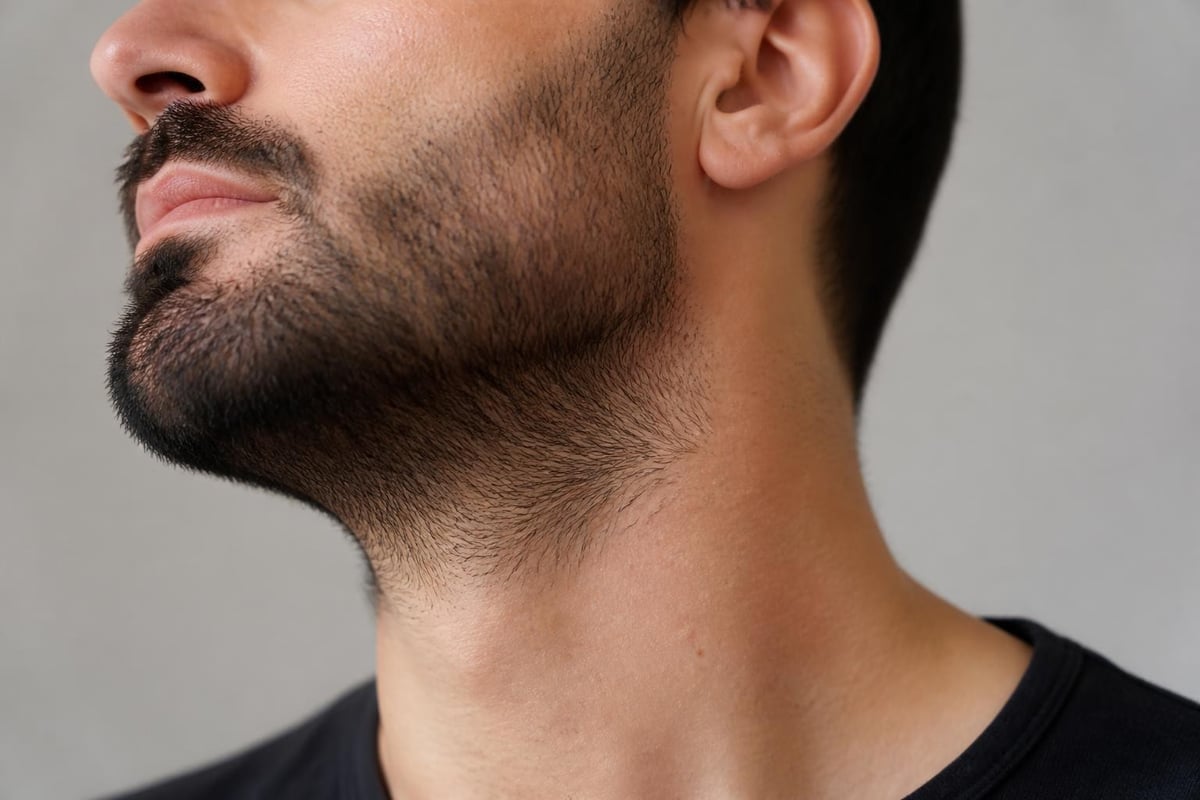
Essential Tools for Professional-Quality Beard Cutting
Problem: The £15 clipper set from your local chemist lacks the precision engineering required for detailed beard work. Consumer-grade trimmers use blunt ceramic blades that crush hair shafts rather than slicing cleanly through keratin protein structures.
Quality beard trimmers feature titanium-coated stainless steel blades that maintain sharp edges through 500+ cutting sessions. The blade gap (distance between upper and lower cutting surfaces) measures 0.8-1.2mm on professional models, whilst budget versions exceed 2mm. This gap determines cutting precision-wider gaps create ragged edges that split within 48 hours.
Agitation: Dull blades generate friction heat that damages the hair cuticle (outer protective layer), exposing the cortex to environmental stressors. Each crushing cut weakens the disulphide bonds holding keratin chains together, accelerating breakage and creating the illusion of slower growth. Your beard appears thinner not because follicles stopped producing hair, but because existing strands snap before reaching visible length.
Building Your Cutting Arsenal
| Tool Type | Purpose | Key Specification | Investment Range |
|---|---|---|---|
| Adjustable Trimmer | Overall length reduction | 0.5mm increments, 90-min runtime | £80-£150 |
| Detail Trimmer | Neckline and cheek definition | 0.1mm precision, T-blade design | £35-£70 |
| Beard Scissors | Individual hair correction | 5.5-inch length, convex edge | £25-£45 |
| Fine-Tooth Comb | Lifting and sectioning | 1mm tooth spacing, anti-static | £8-£15 |
| Outline Shaper | Template guidance | Adjustable curve, medical-grade silicone | £12-£20 |
The best beard trimmer models reviewed for 2026 emphasize cordless operation with lithium-ion batteries that maintain consistent blade speed throughout the charge cycle. Voltage drops in cheaper models slow cutting speed mid-session, increasing the risk of pulling and uneven results.
Solution: Invest in tools that match your beard's density and your style complexity. Fine, straight facial hair tolerates entry-level equipment, whilst coarse, curly beards demand professional-grade precision. Clean blades after every use with the included brush, then apply a single drop of clipper oil to reduce friction and prevent rust formation on cutting surfaces.
Mastering the Foundational Mens Beard Cut Techniques
The transformation from overgrown to sculpted requires systematic execution across four distinct phases. Each phase addresses specific structural elements whilst preserving your beard's natural growth advantages.
Phase One: Establishing Overall Length
Wash your beard with a pH-balanced cleanser to remove styling products and accumulated sebum. The natural oils, whilst beneficial for health, create a coating that prevents accurate length assessment. Pat dry to 80% moisture-completely dry hair compresses differently than slightly damp strands.
Select your desired guard length, then add one increment longer. Facial hair compresses during cutting, then springs back when released, creating a final length shorter than the guard setting indicates. For a 10mm beard, start with the 12mm guard.
Execute the cut using these directional strokes:
- Cheeks: Move trimmer downward from sideburns to jawline, following natural growth
- Jawline: Sweep horizontally from chin toward ears on both sides
- Neck: Work upward from collarbone to jaw, stopping 2cm above your Adam's apple
- Moustache: Trim downward from nose to upper lip, keeping blade flat
Complete two full passes before assessing results. The first pass removes bulk, whilst the second catches resistant hairs that deflected during initial contact.
Phase Two: Creating Shape Definition
Your face shape dictates optimal beard architecture. The mens beard cut techniques that flatter oval faces create imbalance on square or round structures. Beard styles matched to facial structure prevent the common mistake of fighting your natural proportions.
For round faces: Create vertical length by keeping sides shorter than chin area. The contrast generates an elongating effect that counteracts facial width.
For square faces: Soften angular jawlines by maintaining fuller sides that round out sharp corners. Avoid harsh lines at the cheek border.
For oval faces: Nearly any beard geometry works, but balanced proportions (equal length at sides and chin) complement the face's natural harmony.
Remove the guard and activate your trimmer's precision mode. Define your neckline by placing two fingers above your Adam's apple-this marks the natural beard boundary. Anything below gets removed completely, creating the clean separation between beard and neck.
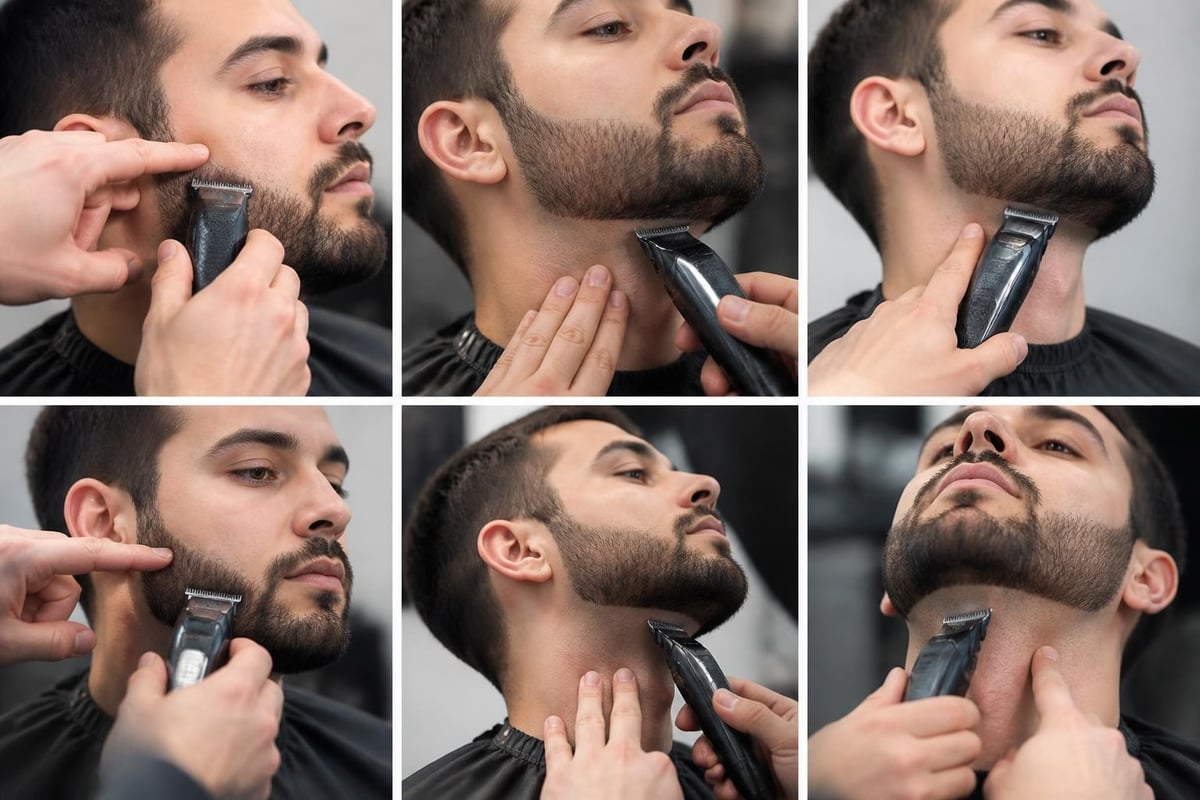
Phase Three: Texturizing and Blending
Professional barbers never create uniform length across the entire beard. Strategic graduation (length variation) produces dimension and prevents the "painted-on" appearance of amateur cuts.
Use your detail trimmer without a guard to create these gradual transitions:
- Sideburn integration: Taper from full beard thickness to skin over 15-20mm vertical distance
- Cheek line softening: Remove the harsh guard line by making 3-4 passes with decreasing pressure
- Moustache blending: Reduce length slightly where moustache meets beard corners
- Underlip detail: Thin the soul patch area to prevent overwhelming the lower lip
The science behind blending involves manipulating how light reflects off hair surfaces. Uniform length creates flat, one-dimensional reflection, whilst graduated lengths scatter light across multiple angles, generating depth perception.
Phase Four: Detailed Refinement
Switch to beard scissors for the final precision work. Comb a small section forward, then trim any hairs extending beyond the general outline. This technique, called "point cutting," creates natural-looking edges rather than blunt lines.
Address individual problem areas:
- Stray long hairs: Isolated strands growing 5mm+ beyond surrounding beard
- Split ends: Damaged tips appearing lighter in colour or frayed
- Cowlick correction: Hairs growing perpendicular to desired direction
- Symmetry adjustments: Length differences between left and right sides
The step-by-step trimming guide from Philips emphasizes checking your work in natural daylight, which reveals imperfections hidden under bathroom lighting.
Maintaining Your Cut Between Professional Sessions
Problem: A perfect mens beard cut deteriorates within 7-10 days without maintenance intervention. The average beard grows 0.4mm daily, translating to 2.8mm weekly growth that destroys carefully crafted lines and proportions.
Agitation: Neglecting interim maintenance forces complete re-cutting every fortnight, removing more length than necessary and preventing you from ever achieving substantial beard goals. The constant restart cycle keeps you trapped in short-beard territory, never experiencing the presence and versatility that come with 50mm+ length.
Daily Maintenance Protocols
Implementing a structured daily routine preserves your cut's integrity whilst promoting healthier growth:
Morning routine (3 minutes):
- Rinse with cool water to remove sleep-induced tangles
- Apply beard oil whilst hair remains damp-the water helps distribute product
- Brush using downward strokes to train growth direction
- Define cheek and neck lines with your detail trimmer if lines become visible
Evening routine (2 minutes):
- Wash with beard-specific cleanser to remove environmental particles
- Apply beard butter for overnight conditioning
- Comb through to ensure even product distribution
The fatty acids in quality beard products-oleic acid, linoleic acid, and palmitic acid-penetrate the hair cuticle to strengthen keratin bonds from within. This internal fortification reduces breakage, allowing you to maintain length whilst keeping shape precise.
For those committed to transforming their facial hair, the 90-Day Beard Challenge provides a complete system of scientifically-formulated products designed to work synergistically. The kit includes follicle-igniting boosters that increase blood flow to hair roots, delivering the oxygen and nutrients required for optimal growth, combined with hydration formulas that maintain the structural integrity needed for successful shaping.

Weekly Touch-Up Schedule
Reserve 15 minutes every Sunday for preventative maintenance:
- Neckline redefinition: The fastest-growing area requiring weekly attention
- Cheek line cleanup: Remove strays that migrate above your established border
- Length verification: Check overall uniformity and address any sections growing faster
- Moustache trimming: Keep upper lip hair from crossing onto your lip
Document each session with a quick photograph. Monthly comparison reveals subtle changes invisible during daily observation, helping you identify areas requiring adjusted cutting techniques.
Advanced Styling Techniques for Different Beard Lengths
The cutting approach shifts dramatically as your beard transitions through length categories. What works for 5mm stubble creates disaster at 40mm full-beard length.
Short Beard Cuts (3-10mm)
Precision matters most at minimal length. Every 0.5mm variation shows clearly against skin, making guard selection critical. Use your trimmer's finest increment adjustments-quality models offer 0.3mm steps in this range.
The key challenge involves maintaining consistent pressure. Pushing the trimmer firmly against skin removes more length than light contact, creating visible tracks across your face. Practice on your forearm to develop the muscle memory for even pressure application.
Styling focus: Clean, sharp lines that emphasize your facial structure. The popular beard styles from a barber's perspective demonstrate how minimal-length beards rely entirely on geometric precision rather than fullness.
Medium Beard Cuts (15-30mm)
This versatile length range offers maximum styling flexibility. You maintain professional appropriateness whilst achieving the masculine presence that short beards cannot deliver.
Introduce scissor work for customization:
- Texturizing: Remove bulk without reducing length by thinning interior density
- Shaping: Sculpt rounded or squared profiles independent of guard-based cutting
- Blending: Create seamless transitions between zones with different natural density
Apply beard balm before cutting medium-length facial hair. The product provides grip that prevents slippery strands from escaping your comb, ensuring you trim precisely what you intend to remove.
Long Beard Cuts (35mm+)
Substantial beards require fundamentally different cutting strategies. Guard-based trimming becomes impossible-the blade cannot penetrate dense growth to reach skin level. Scissors become your primary tool, supported by strategic thinning with your detail trimmer.
Work in small sections:
- Comb a 20mm-wide section straight down
- Hold the hair between your fingers at desired final length
- Cut everything extending beyond your fingers
- Release and observe how the hair settles naturally
- Correct any obvious length discrepancies
Long beards develop natural curl patterns that affect cutting decisions. Curly hair springs back 20-40% after cutting, whilst straight hair maintains 95% of cut length. Account for this elasticity by cutting curly beards 5-8mm longer than your target finished length.
Common Cutting Mistakes and Scientific Solutions
Problem: Even experienced beard groomers fall into predictable cutting traps that undermine their results. These errors stem from misunderstanding facial hair biology rather than lack of technical skill.
Mistake One: Cutting Dry Hair
The hair shaft absorbs water, expanding its diameter by 15-20%. This hydrated state represents how your beard appears after washing-its most voluminous condition. Cutting dry hair removes less actual length than you perceive, because the dehydrated strands compress and appear shorter than their hydrated reality.
Solution: Always cut beard hair at its maximum hydration. Spray with water if it dries during extended cutting sessions. The consistent diameter ensures predictable results matching your intentions.
Mistake Two: Rushing the Process
Keratin fibers possess directional grain like wood. Cutting rapidly forces the blade to crush through hair rather than slicing cleanly along the grain. This crushing action damages the cuticle, creating rough edges that tangle and attract dirt particles.
Solution: Move your trimmer at 3-5cm per second-slow enough to hear individual hairs being cut. The audible feedback confirms the blade is cutting rather than ripping. Quality results require 15-25 minutes depending on density and length.
Mistake Three: Inconsistent Viewing Angles
The mens beard cut that looks symmetrical in your bathroom mirror reveals dramatic imbalance when viewed from the side. Most men cut whilst facing directly forward, never verifying profile appearance until after completion.
Solution: Use a three-way mirror or position two mirrors at 45-degree angles. Check front, both profiles, and both three-quarter views after every major cutting phase. Your beard lives in three-dimensional space-cut it accordingly.
| Common Mistake | Biological Impact | Correction Method |
|---|---|---|
| Cutting against growth direction | Follicle trauma, ingrown hairs | Map growth, follow natural patterns |
| Over-thinning | Cuticle exposure, accelerated damage | Thin maximum 20% of total volume |
| Ignoring split ends | Damage propagates up shaft | Trim 2mm above visible split |
| Uniform length everywhere | Flat, lifeless appearance | Graduate lengths for dimension |
Seasonal Adjustments to Your Cutting Routine
Facial hair responds to environmental conditions as dramatically as scalp hair. The mens beard cut that thrives in February requires modification for July conditions.
Winter considerations (November-March):
- Maintain slightly longer length for insulation and wind protection
- Increase cutting frequency-indoor heating accelerates growth
- Focus on moisturizing products to combat dry air damage
- Protect ends with balm before outdoor exposure
The cold air constricts blood vessels in facial skin, reducing nutrient delivery to follicles. Compensate by incorporating beard growth products that stimulate circulation through ingredients like caffeine or capsicum extract.
Summer considerations (May-September):
- Trim closer for cooling and reduced maintenance
- Address sun damage to hair ends with monthly trimming
- Switch to lighter oils that don't feel heavy in heat
- Increase washing frequency to remove sweat and environmental debris
UV radiation degrades keratin protein bonds through photochemical reactions. The beard acts as a protective barrier for facial skin, but the outermost hairs sacrifice themselves in the process. Regular trimming removes this photo-damaged hair before splits propagate deeper.
Transition periods (April, October):
- Reassess your baseline length for the coming season
- Deep-condition to repair accumulated damage
- Adjust product formulations as humidity changes
- Plan major style changes during these adaptation windows
Matching Your Cut to Lifestyle Requirements
Your occupation, hobbies, and social commitments should inform cutting decisions. The perfect mens beard cut balances aesthetic preferences with practical functionality.
Professional Environment Considerations
Corporate settings typically demand conservative grooming that signals attention to detail. Your beard should appear intentional rather than accidental-sharp lines, consistent length, and visible daily maintenance.
Acceptable professional ranges:
- Finance/Legal: 3-15mm maximum, emphasis on clean lines
- Creative Industries: 5-40mm acceptable, artistic shaping encouraged
- Technology: 5-30mm standard, style flexibility high
- Healthcare: Varies by role; patient-facing often requires shorter lengths
The science supports beard professionalism: research shows well-maintained facial hair increases perceived trustworthiness by 11% compared to unkempt beards, whilst having no negative impact versus clean-shaven faces in professional contexts.
Athletic Activity Requirements
Physical activities generate forces that disrupt beard structure. Runners face wind resistance that tangles hair, swimmers endure chlorine damage, and contact sports risk beard-pulling injuries.
High-impact activities: Maintain 3-10mm length to minimize movement and reduce grab risk. Apply water-resistant beard oil before swimming to create a protective barrier against chlorine and salt water.
Endurance activities: Medium lengths (15-25mm) balance presence with manageability. Use beard balm to hold hair in place during extended exertion, preventing the fraying that occurs when sweat-dampened hair whips in the wind.
Combat sports: Regulations often mandate specific length limits. Cut well below maximum allowed length to ensure you remain compliant as growth occurs between official measurements.
Understanding various men's facial hair styles helps you select cuts that work within your lifestyle constraints whilst maintaining your desired aesthetic impact.
Mastering the mens beard cut transforms your facial hair from an afterthought into a defining style element that commands respect and attention. The systematic approach outlined here-understanding growth patterns, investing in quality tools, executing precise techniques, and maintaining results-delivers professional results without professional prices. When you combine expert cutting techniques with scientifically-formulated grooming products, you create the optimal environment for beard excellence. Onesociety provides the natural, research-backed products your beard needs to thrive between cuts, ensuring every trim reveals healthier, fuller facial hair that holds its shape and radiates vitality.