

The beard hair growth products that work are the ones that support the conditions your follicles need: a healthy scalp-like skin environment under the beard, good hydration, and a routine you keep up for months. No oil or serum can create follicles you do not have, so the realistic goal is to help the hair you carry grow fuller, stronger and less patchy-looking.
That distinction matters, because the aisle is full of promises. Some products have a clear biological rationale. Others borrow the language of science and deliver little. This guide separates the two, explains the mechanisms in plain terms, and shows you how to build a routine that gives your beard its best chance.
Why Your Beard Looks Patchy (and Why It Gets Worse Without Care)
Patchy growth usually comes down to genetics and hormones, and poor skin care makes it look worse.
Beard follicles respond to dihydrotestosterone (DHT), a hormone that tells facial hair to thicken. How many follicles you have, and how sensitively they respond to DHT, is largely inherited. You cannot change that with a bottle.
Now picture the daily reality. You grow a few weeks of stubble, the skin turns tight and itchy, and you scratch. Dry skin flakes, hairs bend back into the skin, and the whole area looks uneven. You decide the beard "does not grow", shave it off, and start again. Sound familiar?
Here is what you can influence:
- Skin hydration: dry, tight skin sheds flakes that clog follicle openings.
- Breakage: brittle hair snaps before it reaches length, which makes growth look slower than it is.
- Inflammation: irritated follicles can produce weaker hair.
- Consistency: hair grows roughly a centimetre a month, so progress only shows if you leave it alone long enough.
The American Academy of Dermatology suggests that if you have sparse areas, you choose a style that suits your growth pattern or let nearby longer hairs grow to cover the gaps. That is sensible advice, and it pairs well with good skin care.
What Actually Stimulates Hair Growth on the Face?
Facial hair growth is driven by hormones, blood supply to the follicle, nutrition and a calm skin environment, and products can only influence the last three.
Think of each follicle as a tiny factory. DHT sets the production target. Blood vessels deliver oxygen and nutrients. If the factory is clogged with dead skin, inflamed or starved of raw materials, output drops.
This is where the useful ingredients come in. Each one maps to a specific job:
| Ingredient | Biological function | What it helps with |
|---|---|---|
| Shea butter | Fatty acids (oleic and stearic) soothe inflammation and seal moisture | Dry, itchy skin under the beard |
| Jojoba oil | Closely resembles skin's own sebum, so it moisturises without clogging pores | Skin balance and soft hair |
| Argan oil | Rich in vitamin E, an antioxidant that protects hair lipids from oxidative damage | Reducing breakage |
| Castor oil | Ricinoleic acid has anti-inflammatory properties and coats the hair shaft | Softening and sealing |
| Peppermint oil | Menthol causes local vasodilation, widening blood vessels near the skin surface | Warmth and circulation |
| Tea tree oil | Terpinen-4-ol has antimicrobial action against skin microbes | Flaking and itch |
Notice the pattern. None of these "grow" hair directly. They remove obstacles. That is an honest description of what most natural beard hair growth products do, and it is why a clean, consistent routine beats any single miracle ingredient.
Does Minoxidil Work for Beard Growth?
Minoxidil may help some men, but it is a medicine rather than a grooming product, and it comes with real risks on facial skin.
Minoxidil is a vasodilator that was developed for blood pressure and later found to stimulate hair growth. It is approved for hereditary hair loss on the scalp. Its use on the face is off-label, and the AAD notes that it is FDA-approved for scalp hair loss and that facial use commonly causes raw, irritated skin. The same source advises talking with a dermatologist before trying it for sparse or patchy beards.
So what should you weigh up?
- Results are not guaranteed. Growth, where it appears, tends to be gradual and may fade if you stop.
- Irritation is common. Dryness, flaking and redness can make the very skin problems you are fighting worse.
- It needs medical advice. A dermatologist or pharmacist can check whether it suits you.
This is also the question behind "Can Rogaine help with beard growth?". Rogaine is a minoxidil brand, so the answer is the same: possibly, with caveats, and only after professional advice. If you want to improve the beard you already have without a prescription-style approach, a skin-first routine is the lower-risk starting point.
The Daily Routine That Gives Your Beard the Best Chance
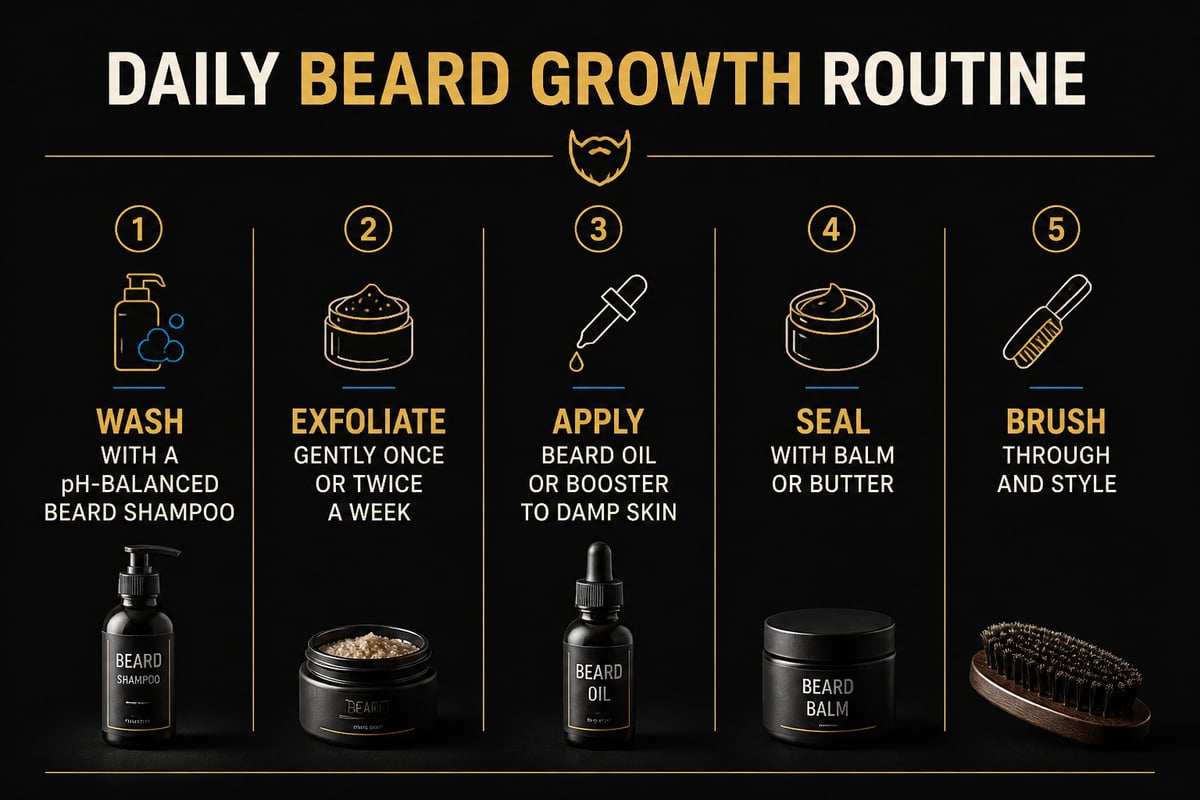
A good routine has five steps: wash, exfoliate lightly, hydrate, protect and style, and you repeat them every day for at least three months.
Why three months? A single hair follicle runs through growth cycles lasting years, but you only see visible change when enough hairs have grown past the skin line. Anything shorter and you are judging a beard before it has had time to show you anything.
Step 1: Wash with a pH-balanced shampoo
Skin sits at a slightly acidic pH. Harsh soaps strip oils and raise skin pH, which dries the skin and weakens the hair's outer layer. A dedicated beard shampoo cleans without stripping.
Step 2: Exfoliate gently
During the stubble phase, hairs are short and sharp enough to curl back into the skin. The AAD recommends gentle exfoliation once or twice a week to help prevent ingrown hairs, followed by moisturising. Removing dead cells keeps follicle openings clear.
Step 3: Hydrate the skin first
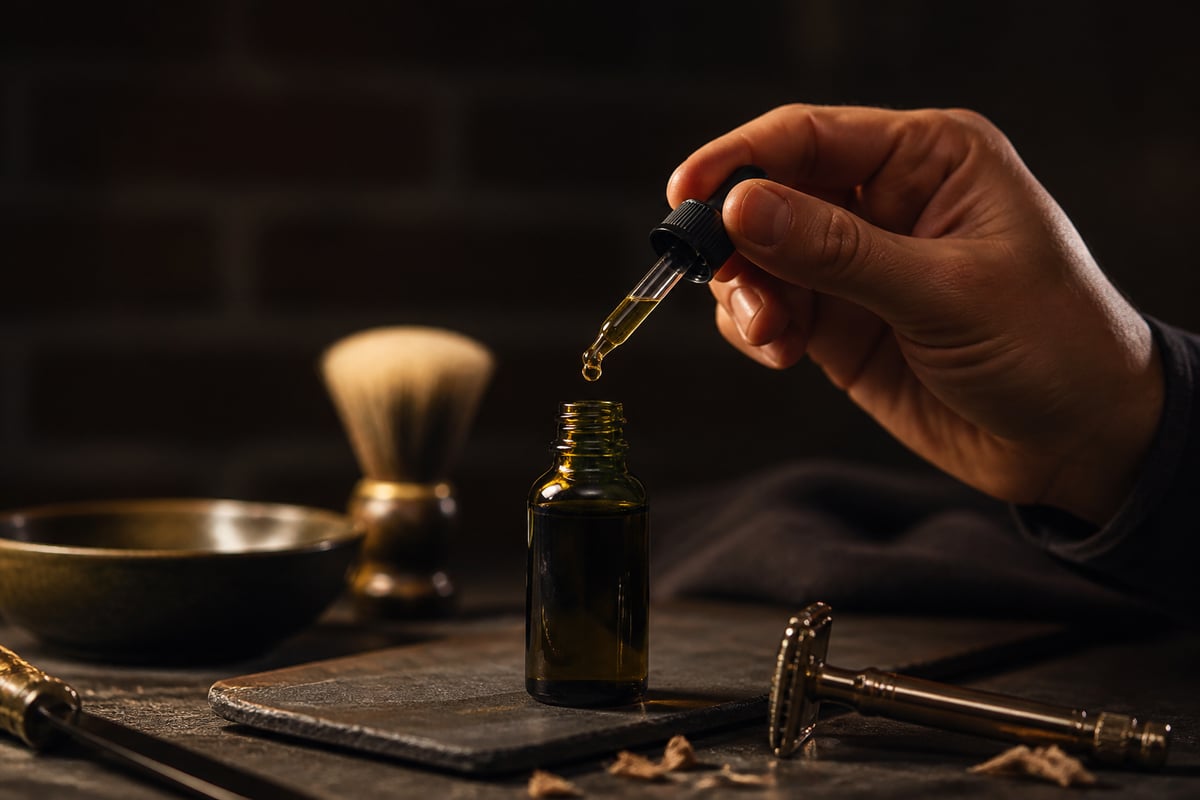
Apply a lightweight oil or serum to damp skin. Water already in the skin gets sealed in, and the oil carries nutrients down to the follicle opening. If you want a deeper look at oils, this guide to beard hair growth oil walks through how they work.
Step 4: Seal and protect
A balm or butter forms a thin barrier on the hair surface, which reduces water loss and friction. Ingredients like shea butter deliver fatty acids that calm irritation, and beeswax or similar waxes add hold. A beard balm works well in the daytime, and a beard butter suits overnight recovery.
Step 5: Protect against sun
Facial skin under short stubble gets sun exposure. The AAD advises a moisturiser with SPF 30 or higher chosen for your skin type. Sun damage dries skin and hair, which works against everything else you are doing.
Which Beard Hair Growth Products Are Worth Buying?
The products worth buying are those with a clear job, a transparent ingredient list and no irritants that undo their own benefits.
Use this checklist when you read a label:
- Does it explain why each ingredient is there? Vague "growth complex" wording is a warning sign.
- Is it free from heavy synthetic fillers? Silicones and mineral oil coat hair but leave skin congested.
- Is it gentle enough for daily use? Facial skin is thinner than scalp skin.
- Does the brand back its claims? A money-back guarantee tells you the company expects results from a fair trial.
By format, here is how the main categories compare:
| Product type | Main job | Best used |
|---|---|---|
| Beard shampoo | Clean without stripping | 2 to 4 times a week |
| Beard oil or booster | Hydrate skin, soften hair | Daily, on damp skin |
| Beard balm | Seal moisture, add light hold | Daily, after oil |
| Beard butter | Deep overnight conditioning | Evening |
| Beard brush or comb | Spread product, lift hairs | Daily |
For more comparisons, browse these roundups of best beard growth products and beard hair growth serum options.
The Problem With Buying One Product at a Time
Buying single products one after another leaves gaps in your routine, and each gap lets dryness, itch or breakage creep back.
Here is how it usually goes. You buy an oil. It softens the hair, but the skin underneath still flakes because you are washing with supermarket shampoo. You add a balm. Now the beard feels heavy, because the skin was never clean. Weeks pass, results look unconvincing, and you lose patience. The beard never got a fair test.
The fix is a system where each step supports the next. That is the idea behind the 90-Day Beard Challenge, a single kit built around the routine above. It combines a Beard Booster, a Beard Shampoo, a Beard Balm with a Hydro-Lock protective shield, a Beard Butter for overnight recovery and a conditioner, plus other formulas, in one box.
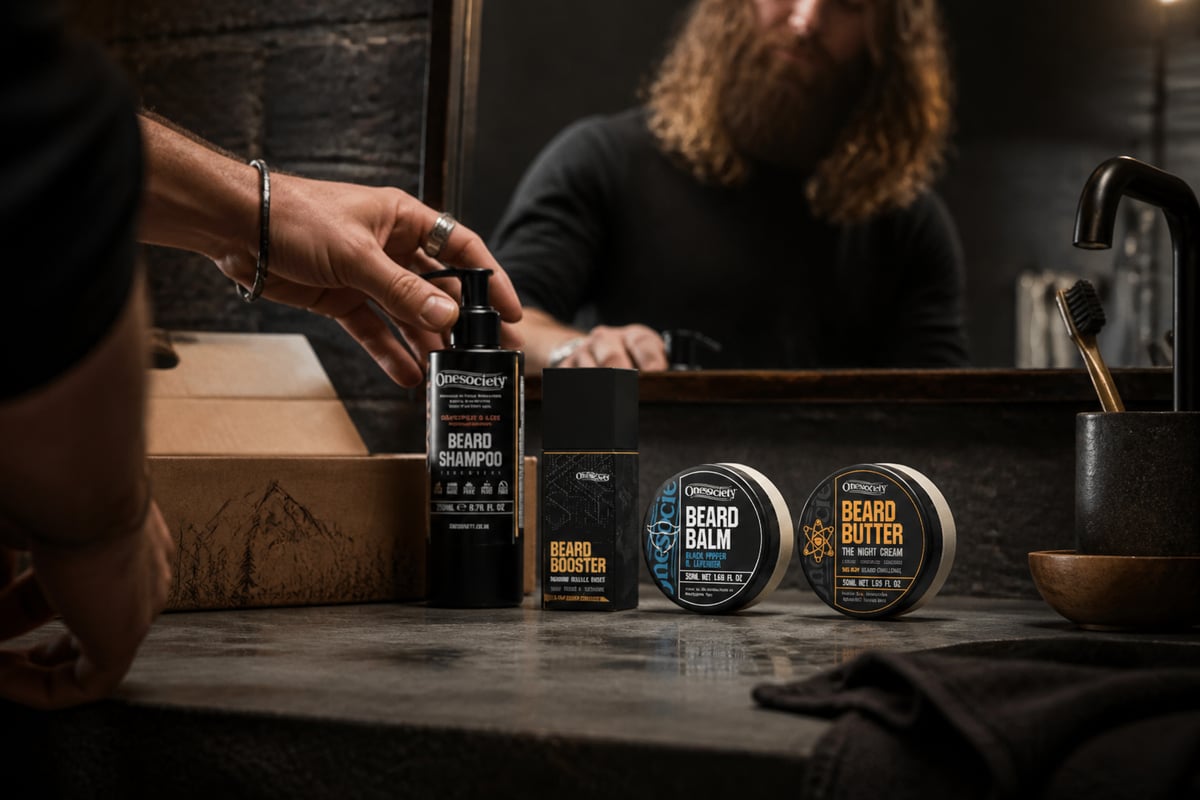
Why does it suit the problem? Each formula uses natural ingredients, so the claims rest on the ingredients rather than marketing language. The products are designed to be non-greasy and to address the irritation and congestion that can stall growth. It also carries a full refund guarantee, so you can test it properly rather than guessing. Onesociety has served many satisfied customers, and Google-verified reviews include comments such as "Beard felt amazing after first wash".
Ready to see it? Buy the 90-Day Beard Challenge now. You can also find individual items on Amazon through the OneSociety Amazon store.
If you prefer to start smaller, the Beard Growth Oil and the Day and Night Beard Growth Kit cover the hydration and recovery steps.
What Is the Best Time to Apply Beard Oil?
The best time to apply beard oil is straight after a shower, when the skin is damp and the pores are open.
Warm water softens the skin and leaves moisture on the surface. Oil applied then slows evaporation and locks that water in. Dry skin absorbs oil less evenly and the product tends to sit on top of the hair instead.
A simple pattern works for most men:
- Morning: two or three drops on damp skin after washing, for hydration and a soft finish.
- Evening: a second application, or a butter, so the skin recovers while you sleep.
Use less than you think. Heavy application makes the beard greasy and traps dirt. Warm the oil between your palms, work it down to the skin first, then smooth through the length.
How Long Before You See Results?
You should expect the first changes in softness and skin comfort within two to four weeks, and changes in density and length over three months or more.
This timeline follows the biology. Hydration and itch improve fast because they depend on the skin barrier, which repairs within days. Hair length depends on follicle speed, roughly a centimetre a month. Apparent density depends on thin hairs maturing and breakage falling, which takes several cycles.
Set yourself a few honest checkpoints:
- Week 2: less itch and flaking.
- Week 6: softer, more manageable hair, fewer split ends.
- Week 12: visible length, and gaps looking smaller as nearby hairs lengthen.
Take a photo in the same light every two weeks. Daily mirror checks fool you, but photos show real change.
When to See a Dermatologist
See a dermatologist if you notice sudden patches, persistent redness, scaling or pain, because these can signal conditions that products will not fix.
Sudden round bald patches in a beard may point to alopecia barbae, an autoimmune condition. Persistent itching and scaling can indicate fungal infection or dermatitis. The AAD advises seeing a dermatologist for persistent skin problems or hair loss. Treating the underlying cause first protects both your skin and your investment in products.
FAQ
What are some good beard products available in the UK?
Look for a pH-balanced beard shampoo, a lightweight oil, and a balm or butter made with natural ingredients and a transparent label. UK brands such as Onesociety sell these as a beard starter kit as well as individually, so you can build a routine step by step.
Can diet and sleep affect beard growth?
Yes. Hair is made of protein and needs iron, zinc and B vitamins to form properly, and deficiencies can slow growth. Sleep matters because the body repairs tissue and regulates hormones overnight, so poor sleep can work against your routine.
Is it safe to use beard oil every day?
For most men, yes, provided the formula is gentle and non-comedogenic. Use a small amount on clean, damp skin, and stop if you notice redness or breakouts.
Start tonight by taking a clear photo of your beard in daylight, then wash with a pH-balanced shampoo and apply a few drops of oil to damp skin, so you have a baseline to measure against. If you want every step in one box, the 90-Day Beard Challenge gives you the full routine with a full refund guarantee, so you can test it properly and Accept Challenge with nothing to lose.