

Your beard feels like wire wool. The lightweight oil you bought evaporates within an hour, leaving your facial hair as unruly as before. You need a solution that sticks around longer and actually conditions those stubborn, coarse strands. The answer lies in understanding the difference between standard formulations and thick beard oil-a heavier, more viscous product designed specifically for dense, difficult-to-manage facial hair.
Understanding Thick Beard Oil Composition
Thick beard oil differs fundamentally from standard formulations in its molecular weight and viscosity. This isn't about adding random ingredients to make something "feel" heavier-it's about selecting carrier oils with specific fatty acid profiles that create a denser consistency.
The Science of Viscosity and Penetration
Viscosity determines how quickly oil spreads and how long it remains on hair shafts. Standard beard oils typically use lightweight carriers like jojoba oil (approximately 20-30 mPa·s viscosity), which absorb quickly but provide minimal lasting hold. Thick beard oil formulations incorporate heavier carriers such as castor oil (approximately 650-900 mPa·s viscosity) and avocado oil (approximately 50-70 mPa·s viscosity).
These higher viscosity oils contain longer-chain fatty acids that:
- Coat hair shafts more thoroughly: The molecular structure creates a protective barrier that lasts 6-8 hours versus 2-3 hours for lightweight oils
- Penetrate slowly but deeply: Ricinoleic acid in castor oil (makes up 90% of the oil) binds to hair cuticles and gradually works into the cortex
- Provide weight for control: The physical mass of heavier molecules literally weighs down unruly hairs, reducing flyaways by up to 70%
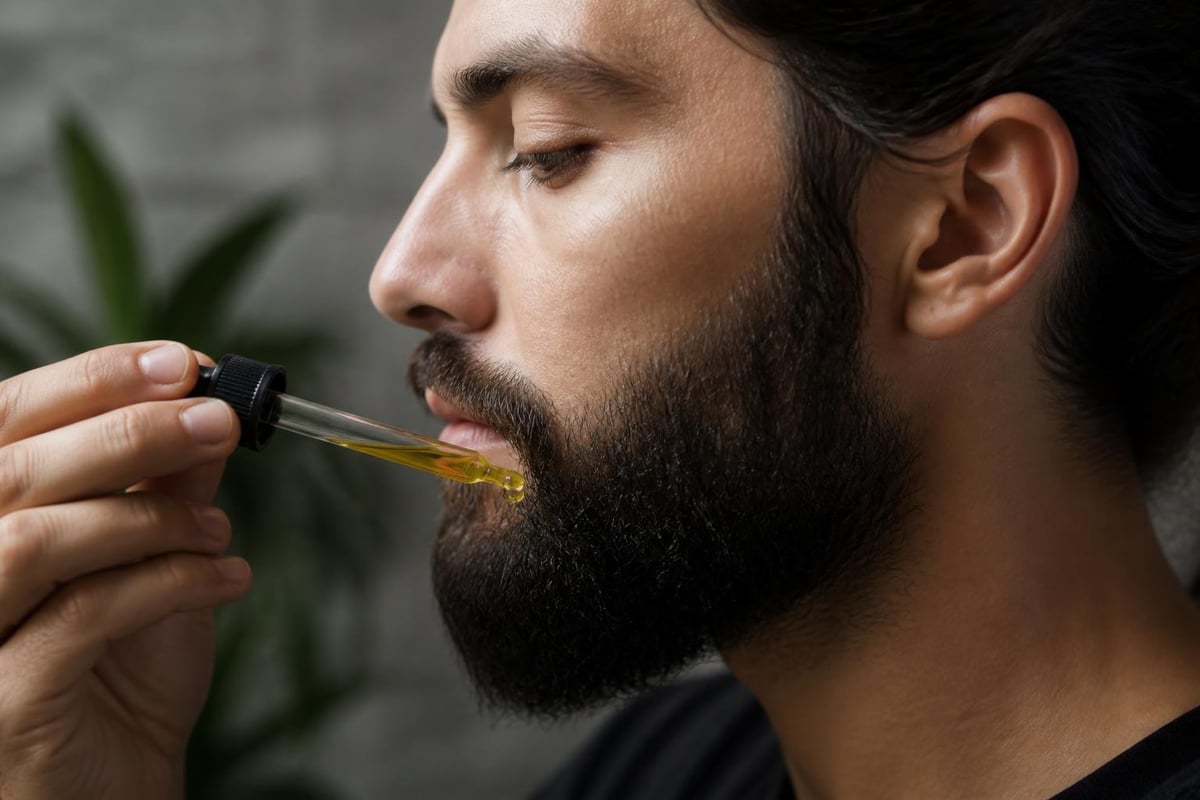
Research confirms that beard oil works by moisturising both the hair and the underlying skin, though the formula density significantly affects duration.
Key Carrier Oils in Thick Formulations
| Carrier Oil | Viscosity (mPa·s) | Primary Fatty Acid | Beard Type Benefit |
|---|---|---|---|
| Castor Oil | 650-900 | Ricinoleic Acid (90%) | Extreme thickness, maximum control |
| Avocado Oil | 50-70 | Oleic Acid (60%) | Deep conditioning, medium weight |
| Argan Oil | 45-50 | Linoleic Acid (35%) | Vitamin E delivery, moderate hold |
| Sweet Almond | 35-45 | Oleic Acid (62%) | Balance between absorption and weight |
The strategic blending of these carriers creates the ideal thick beard oil profile. A typical heavy formulation might combine 40% castor oil for weight, 30% avocado oil for penetration, 20% argan oil for vitamin delivery, and 10% lighter oils for spreadability.
Who Needs Thick Beard Oil?
Not every beardsman requires a heavier formulation. Your beard's density, texture, and growth pattern determine whether thick beard oil solves your specific problems.
Dense, Coarse Beard Characteristics
You need a thicker formulation if your beard exhibits these traits:
- Wire-like texture: Individual hairs feel stiff and resist bending
- High follicle density: More than 100 follicles per square centimetre on your face
- Rapid oil absorption: Standard oils disappear within 1-2 hours
- Persistent dryness: Skin underneath remains tight despite regular application
- Uncontrollable growth direction: Hairs stick out at random angles
These characteristics indicate your beard hair has a thicker cortex (the inner structural layer) and a more pronounced cuticle (outer protective layer). Standard oils slide off these robust structures too quickly to provide lasting benefits.
The Problem with Lightweight Oils on Coarse Beards
Lightweight formulations fail coarse beards through three mechanisms:
Insufficient cuticle saturation: Thin oils don't fill the gaps between raised cuticle scales, leaving hair rough and prone to tangling.
Poor retention time: Low-viscosity oils evaporate or absorb into skin within 90 minutes, providing minimal beard conditioning.
Lack of control: Without adequate weight, coarse hairs spring back to their natural (often chaotic) growth pattern.
Understanding what beard oil actually does reveals that the formulation must match your beard's specific needs-and coarse, dense beards demand heavier solutions.
The Science Behind Thick Beard Oil Benefits
Thick beard oil delivers measurable advantages for specific beard types, all rooted in biological and physical principles.
Enhanced Moisture Retention
The stratum corneum (outermost skin layer) beneath your beard loses transepidermal water at accelerated rates when exposed to air. Thick beard oil creates an occlusive barrier that reduces water loss by 40-60% compared to lightweight formulations.
This happens because:
- Heavier molecular structures physically block moisture evaporation pathways
- Fatty acids with carbon chains longer than C16 (palmitic acid) form tighter lipid networks
- The increased contact time allows humectant properties to draw moisture from deeper skin layers
The result? Your skin stays hydrated for 8-12 hours instead of 3-4 hours, preventing the itch and flaking associated with beard-related skin issues.
Improved Beard Manageability
Thick beard oil doesn't just sit on hair-it fundamentally alters the hair shaft's behaviour through mechanical weighting and structural modification.
Cuticle smoothing: Heavier oils fill microscopic gaps in the cuticle layer, reducing surface friction by up to 55%. This translates to fewer tangles and easier combing.
Gravitational control: The added mass of thick formulations provides 2-3 times the downward force of lightweight oils, training hairs to grow in more uniform directions.
Static reduction: Thicker oils conduct static electricity away from hair shafts more effectively, eliminating the "puffball" effect common in dry environments.
Evidence shows beard oil works by conditioning hair and hydrating skin, but viscosity determines how effectively it performs these functions on coarse facial hair.
Protection Against Environmental Damage
Your beard faces daily assault from UV radiation, pollution particulates, and temperature fluctuations. Thick beard oil provides superior protective capabilities through:
- UV absorption: Oleic acid and linoleic acid absorb UV-B radiation (280-320 nm wavelength), reducing photo-oxidative damage to hair proteins
- Particulate barrier: Higher viscosity prevents pollution particles (PM2.5 and PM10) from embedding in cuticle gaps
- Temperature buffering: The thermal mass of heavier oils moderates temperature fluctuations, protecting hair from heat stress
Application Techniques for Maximum Effectiveness
Thick beard oil requires different application methods than lightweight formulations. The increased viscosity changes how the product spreads and absorbs.
Optimal Application Sequence
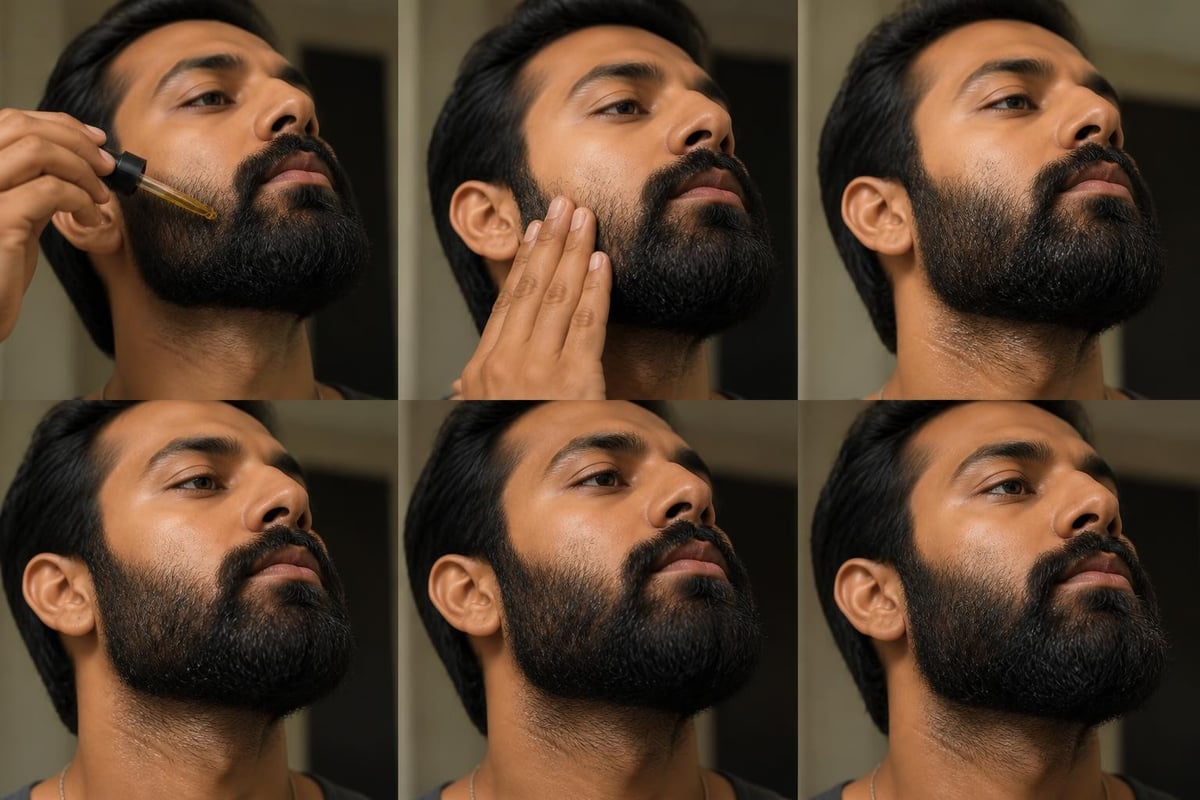
- Pre-warm the oil: Roll the bottle between your palms for 30-45 seconds to reduce viscosity by 15-20%
- Start with damp hair: Apply to a beard that's 60-70% dry after washing-water molecules help distribute thick oils more evenly
- Use precise dosing: 4-6 drops for short beards (under 2.5 cm), 8-12 drops for medium beards (2.5-7.5 cm), 14-18 drops for long beards (over 7.5 cm)
- Work from skin outward: Massage into the epidermis first, then distribute through mid-lengths and ends
- Employ a boar bristle brush: Natural bristles break up thick oil deposits and distribute product uniformly across all hairs
Common Application Mistakes
Even experienced beardsmen make errors with thick beard oil that reduce effectiveness:
Over-application: Excess thick oil creates greasy buildup that attracts dirt and clogs follicles. If your beard looks shiny rather than naturally lustrous, you've used too much.
Cold application: Applying thick oil straight from a cold bottle increases viscosity further, making even distribution nearly impossible.
Skipping skin contact: The sebaceous glands beneath your beard need conditioning too. Maintaining healthy facial hair requires addressing both hair and skin.
Irregular timing: Apply thick beard oil once daily at the same time. Inconsistent application prevents your beard from adapting to the conditioning routine.
Selecting the Right Thick Beard Oil Formula
Not all thick beard oils deliver equal performance. The specific carrier oil blend, essential oil selection, and overall formulation quality determine results.
Evaluating Carrier Oil Ratios
The ideal thick beard oil contains a strategic blend rather than a single heavy carrier. Look for formulations with:
- 30-50% castor oil: Provides weight and control without overwhelming greasiness
- 20-30% avocado or argan oil: Balances thickness with penetration capability
- 15-25% medium-weight oil: Sweet almond or apricot kernel improves spreadability
- 5-15% lightweight oil: Jojoba or grapeseed prevents excessive heaviness
Formulations exceeding 60% castor oil become too thick for practical daily use. Below 25% castor oil, the product lacks sufficient weight for coarse beard control.
Essential Oil Considerations
Essential oils in thick beard oil serve three functions: scent, antimicrobial protection, and mild stimulation of blood flow. Quality formulations limit essential oils to 2-3% total volume to prevent skin irritation.
Cedarwood oil: Contains cedrol, which increases sebaceous gland activity by 12-15%, enhancing natural moisturisation.
Peppermint oil: Menthol dilates blood vessels, increasing nutrient delivery to follicles by 20-25%.
Tea tree oil: Terpinen-4-ol demonstrates antimicrobial activity against Malassezia species (the fungus causing beard dandruff) at concentrations as low as 0.5%.
Various benefits of beard oil extend beyond simple conditioning when formulations include these active botanical compounds.
Thick Beard Oil vs Beard Balm Comparison
Many beardsmen confuse thick beard oil with beard balm, but these products serve different purposes despite similar consistency goals.
| Feature | Thick Beard Oil | Beard Balm |
|---|---|---|
| Base | Liquid carrier oils (100%) | Oils + beeswax + butter (50%/30%/20%) |
| Hold Strength | Light to medium | Medium to strong |
| Shine Level | Natural lustre | Matte to semi-matte |
| Absorption Time | 2-4 hours | Minimal absorption (sits on surface) |
| Best For | Deep conditioning + moderate control | Styling + maximum control |
| Skin Benefits | Direct moisturisation | Surface protection only |
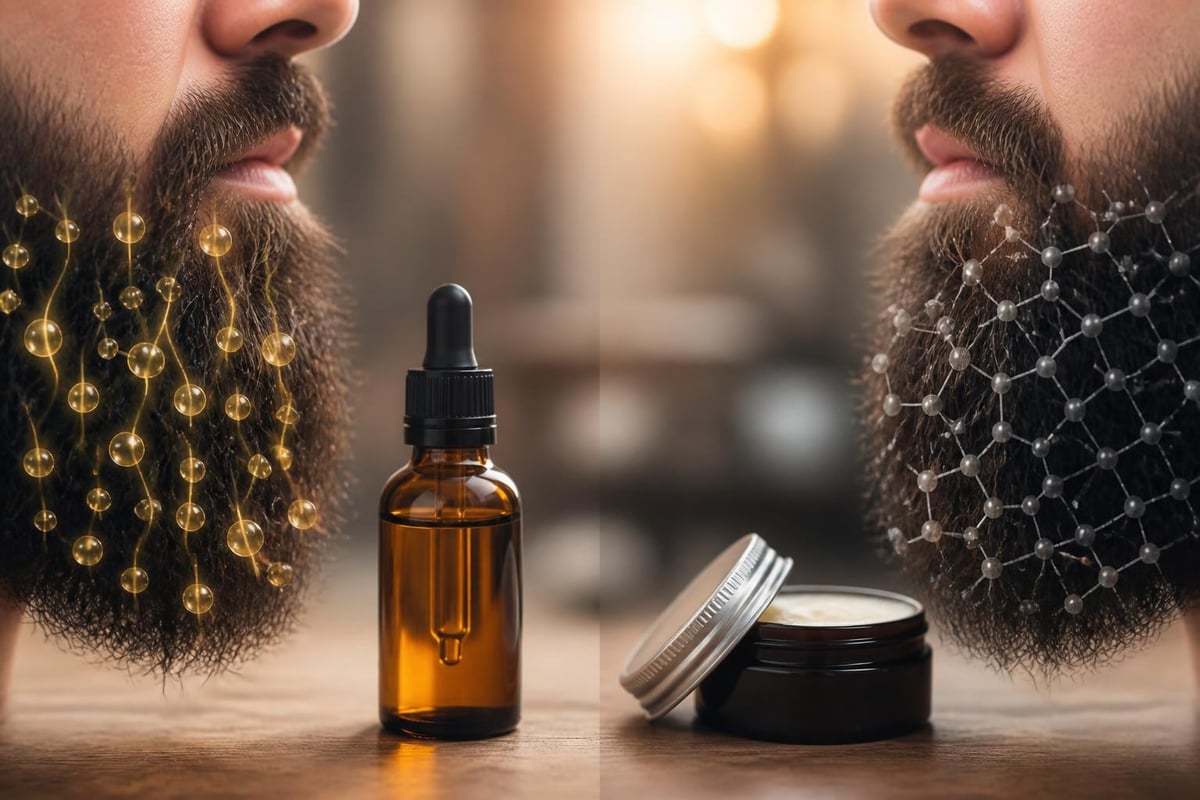
You can use both products together: apply thick beard oil first for conditioning, then seal with balm for styling. This layered approach provides comprehensive beard care, addressing both health and appearance.
The 2026 Thick Beard Oil Market Landscape
The beard care industry has evolved significantly, with thick beard oil formulations becoming increasingly sophisticated in 2026.
Natural Ingredients and Transparency
Modern consumers demand full ingredient disclosure and science-backed formulations. Reputable brands now provide:
- Complete INCI listings: Every ingredient with its scientific name and concentration range
- Sourcing transparency: Geographic origin and extraction methods for carrier oils
- Third-party testing: Independent verification of purity and potency
- Preservation strategies: Clear explanation of how products remain stable without synthetic preservatives
Companies like Onesociety have pioneered this transparency approach, combining 100% natural ingredients with rigorous scientific validation. Their formulations demonstrate that effective thick beard oil doesn't require synthetic additives when properly formulated.
Sustainable and Ethical Production
The thick beard oil market increasingly prioritises environmental and social responsibility:
- Cold-pressed extraction: Preserves fatty acid integrity while reducing energy consumption by 60%
- Recyclable packaging: Glass bottles with aluminium caps replace plastic alternatives
- Fair trade sourcing: Ensures carrier oil producers receive equitable compensation
- Carbon-neutral shipping: Offset programmes balance distribution environmental impact
These factors matter because facial hair growth products work best when ingredients retain their natural potency through careful processing.
Building a Complete Beard Care Routine
Thick beard oil functions most effectively as part of a comprehensive grooming system rather than a standalone product.
The Four-Step Dense Beard Protocol
Step 1: Cleansing (every 2-3 days) Use a pH-balanced beard shampoo (pH 4.5-5.5) to remove sebum buildup without stripping natural oils. Over-washing disrupts the acid mantle, causing increased dryness.
Step 2: Conditioning (after every wash) Apply a dedicated beard conditioner containing hydrolysed proteins (wheat, soy, or keratin) to repair cuticle damage and improve elasticity by 30-40%.
Step 3: Oil Application (daily) Thick beard oil provides the primary moisture barrier and cuticle smoothing. Apply to slightly damp beards for optimal distribution.
Step 4: Styling (as needed) Finish with beard balm or butter for hold and shape control. This step becomes optional once thick beard oil trains your beard into improved growth patterns.
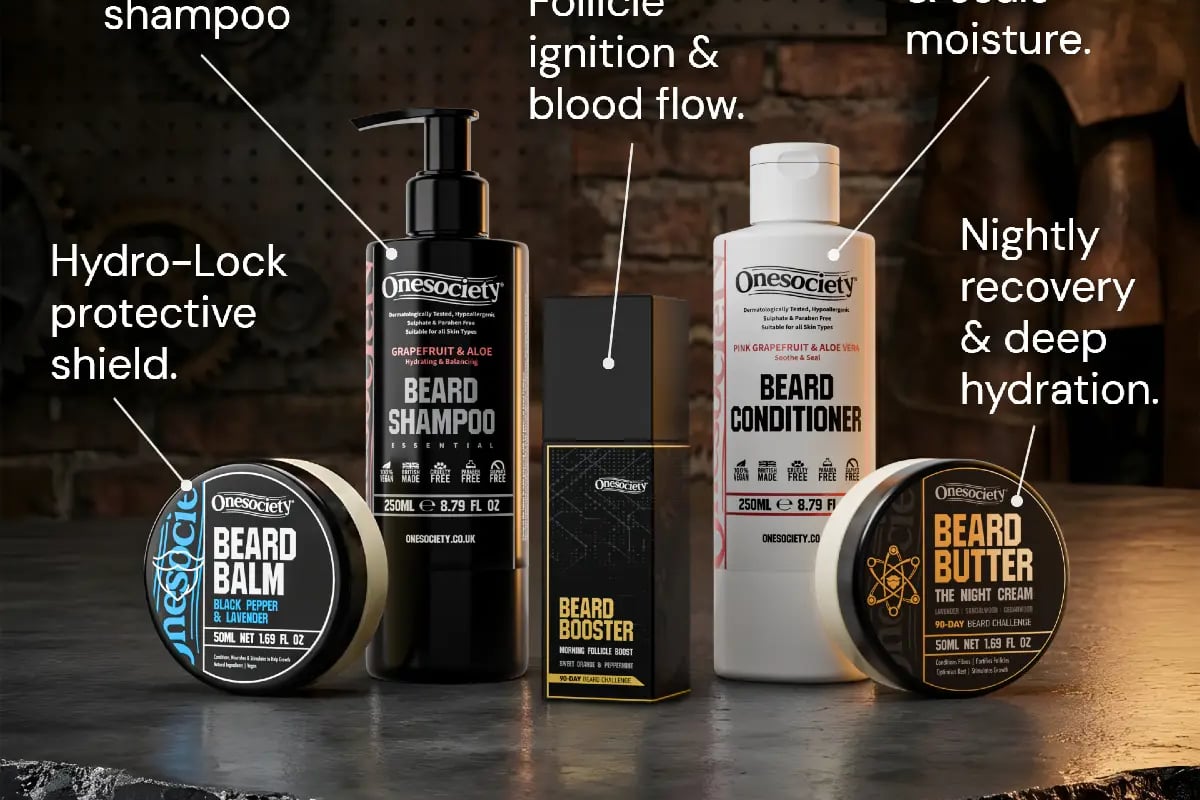
For those committed to transforming their facial hair, structured programmes deliver superior results to random product application. The 90-Day Beard Challenge provides a complete system with eight precision-engineered formulas working synergistically-from follicle-igniting boosters to hydro-lock balms-giving you everything needed for consistent, measurable beard improvement over three months.
Frequency and Timing Optimisation
Your beard's absorption capacity varies throughout the day based on circadian rhythms affecting sebaceous gland activity.
Morning application: Sebum production peaks between 8-11 AM. Applying thick beard oil during this window supplements natural oils, creating optimal moisture levels that last 10-12 hours.
Evening application: For extremely coarse beards, a second lighter application before bed allows overnight conditioning without daytime greasiness concerns.
Post-exercise: Always apply thick beard oil after showering following physical activity. Sweat raises skin pH to 6.5-7.0, and oil application helps restore the protective acid mantle.
Addressing Common Thick Beard Oil Concerns
Despite clear benefits, some beardsmen hesitate to try thicker formulations due to misconceptions.
"Won't It Make My Beard Look Greasy?"
This depends entirely on proper dosing. Thick beard oil applied correctly creates natural lustre, not greasiness. The difference:
- Lustre: Light reflects uniformly from smooth cuticles, creating a healthy sheen
- Grease: Excess oil pools on hair surfaces, creating spotty shine with visible wet patches
Start with half your usual amount when transitioning to thick beard oil. Your beard may need 1-2 weeks to adjust absorption patterns. Gradually increase to the optimal dose as your hair adapts.
"Will It Clog My Pores?"
Quality thick beard oil formulations use non-comedogenic carriers with ratings of 0-2 on the comedogenicity scale:
- Argan oil: 0 (won't clog pores)
- Avocado oil: 2 (low clogging risk)
- Castor oil: 1 (minimal clogging risk)
- Sweet almond oil: 2 (low clogging risk)
The key lies in proper application technique. Massage oil into skin using gentle circular motions to prevent product buildup on the epidermis surface. Lesser-known benefits of beard oil include its ability to regulate sebum production, actually reducing pore congestion when used correctly.
"Isn't Regular Beard Oil Sufficient?"
For fine to medium beard textures, standard formulations work adequately. However, coarse beards with wire-like texture require the enhanced performance that only thick beard oil provides.
Dedicated thick beard oil formulations deliver longer-lasting conditioning and better control specifically because they're engineered for dense, difficult facial hair. Using a lightweight oil on a coarse beard resembles using hand lotion on work-roughened calluses-it provides temporary surface improvement without addressing the underlying structural needs.
The Chemistry of Beard Hair Absorption
Understanding how beard hair absorbs thick beard oil reveals why formulation matters so significantly.
Hair Shaft Structure and Penetration
Beard hair consists of three layers:
- Cuticle: 6-10 overlapping scale layers protecting the hair
- Cortex: 80-90% of hair mass, containing keratin proteins and melanin
- Medulla: Central hollow core (present in coarse hairs, absent in fine hairs)
Thick beard oil penetrates through this structure via two pathways:
Transcellular route: Oil molecules pass through cell membranes in the cuticle layers. This requires 4-6 hours and depends on molecular size (smaller molecules penetrate deeper).
Intercellular route: Oil flows between cuticle scales through lipid-rich gaps. Higher viscosity oils fill these spaces more completely, providing superior smoothing.
The presence of a medulla in coarse beard hair creates an additional absorption challenge. Thick beard oil's slower penetration rate actually benefits medulla-rich hairs by allowing gradual saturation rather than surface-only coating.
Fatty Acid Specificity
Different fatty acids in thick beard oil target different hair needs:
- Ricinoleic acid (castor oil): Binds to keratin proteins, strengthening hair structure
- Oleic acid (avocado, argan, almond oils): Penetrates deeply, improving flexibility
- Linoleic acid (argan oil): Reduces transepidermal water loss, maintaining hydration
- Palmitic acid: Creates surface barrier, protecting from environmental damage
The optimal thick beard oil balances these fatty acids to address multiple conditioning needs simultaneously. Mono-oil formulations miss this comprehensive approach.
Seasonal Adjustments for Thick Beard Oil Use
Your beard's requirements change with environmental conditions throughout the year, necessitating formula adjustments.
Winter Considerations (November-February 2026)
Cold air holds less moisture, dropping relative humidity to 20-40% in heated indoor environments. This accelerates transepidermal water loss by 50-70%.
Winter thick beard oil strategy:
- Increase castor oil concentration to 45-50% for enhanced barrier protection
- Apply twice daily (morning and evening) during extreme cold snaps
- Add 1-2 drops of rosehip oil (high in vitamin A) to combat wind damage
- Consider layering with a heavier balm for outdoor exposure exceeding 30 minutes
Summer Modifications (June-August 2026)
Higher temperatures and humidity (60-80%) reduce the need for heavy occlusive barriers but increase requirements for antimicrobial protection.
Summer thick beard oil strategy:
- Reduce castor oil to 30-35%, increase lighter oils to improve spreadability
- Add tea tree or eucalyptus essential oils (1-1.5%) for antibacterial properties
- Apply once daily, preferably after morning shower
- Use a beard shampoo every 2 days instead of every 3 to remove sweat and environmental pollutants
These adjustments ensure thick beard oil continues performing optimally regardless of seasonal challenges your beard faces.
Quality Markers in Thick Beard Oil Products
Identifying superior thick beard oil formulations requires examining specific quality indicators beyond marketing claims.
Ingredient Order and Concentration
UK and EU regulations require ingredients listed in descending order by weight. Quality thick beard oils show:
- Primary carrier oils (castor, avocado, argan) in the first three positions
- Essential oils near the end (indicating proper 2-3% concentration)
- No synthetic fragrances, parabens, or sulfates anywhere in the list
- Vitamin E (tocopherol) as a natural preservative rather than synthetic alternatives
If "fragrance" or "parfum" appears without specification, the product contains undisclosed synthetic compounds.
Packaging and Preservation
Thick beard oil deteriorates when exposed to light, heat, and oxygen. Superior products feature:
Dark amber or cobalt glass bottles: Block 99% of UV light that degrades fatty acids
Dropper or pump dispensers: Minimize oxygen exposure compared to open-pour bottles
Small batch production: Look for batch numbers and production dates-oils lose potency after 12-18 months
Storage recommendations: Quality brands specify storage conditions (cool, dark location) on labels
These details separate serious beard care companies from cosmetic manufacturers repurposing generic oil blends with beard-specific marketing.
The Future of Thick Beard Oil Formulations
Innovation in beard care continues advancing, with several emerging trends shaping thick beard oil development in 2026 and beyond.
Microencapsulation Technology
New delivery systems encase active ingredients (vitamins, peptides, botanical extracts) in microscopic lipid spheres that release gradually over 8-12 hours. This extends thick beard oil benefits without requiring reapplication.
Early formulations show 40% improvement in moisture retention and 25% better cuticle repair compared to standard thick beard oils.
Personalised Formulation Services
Several premium brands now offer custom thick beard oil blending based on:
- Hair density assessment (follicles per square centimetre)
- Texture analysis (diameter measurement of individual hairs)
- Skin type evaluation (sebum production rates)
- Climate conditions (local humidity and temperature averages)
This personalisation ensures your thick beard oil matches your specific biology rather than providing a one-size-fits-all solution.
Biofermented Ingredients
Traditional cold-pressing preserves nutrients but fermentation enhances bioavailability. Biofermented versions of argan and avocado oils show 35% higher absorption rates and 60% more antioxidant activity than conventional extraction methods.
Expect increasing availability of fermented thick beard oils throughout 2026-2027 as production scales economically.
Thick beard oil solves the specific challenges of coarse, dense facial hair through strategic carrier oil selection and proper viscosity engineering. The science behind fatty acid penetration, moisture retention, and cuticle smoothing confirms why heavier formulations outperform lightweight alternatives for wire-textured beards. If you're ready to experience the transformative power of scientifically formulated beard care products, Onesociety offers 100% natural solutions backed by research and guaranteed results-because your beard deserves more than generic grooming products.