

If you type "beard grooming near me" into a search bar, you want a local barber who can shape your beard well, keep tools clean and leave your skin in better shape than they found it. Finding that barber takes about ten minutes of checking, one honest conversation in the chair and a home routine that protects the work between visits.
Most men skip the checking. They pick the closest shopfront, accept a trim they never asked for and leave with a patchy outline and an itchy jaw. Sound familiar? This guide gives you a clear way to avoid that, then shows you how to keep your beard healthy at home.
What a Good Beard Groomer Actually Does
A good beard groomer shapes your beard to suit your face, trims without damaging the hair or skin, and tells you what your beard needs next. A haircut alone does not cover it.
Strong beard work usually includes:
- Shaping the cheek and neck lines so the beard frames your jaw instead of fighting it
- Trimming to your growth pattern, not to a template
- Detailing around the moustache and edges with clippers, scissors or a straight razor
- Skin care, such as a warm towel, a cleanse and a finishing oil or balm
- Honest advice on length, density and patches
Here is the problem with a rushed trim. Beard hair grows from follicles at different angles and speeds, so a one-size cut leaves gaps where growth is slow and bulk where it is fast. Cut too close on a sensitive neck and the freshly cut hair can curl back into the skin, which causes ingrown hairs and red, sore bumps. A skilled barber reads the direction of growth first and cuts with it, which is why the same clippers give very different results in different hands.
How to Search for Beard Grooming Near Me Without Wasting an Afternoon
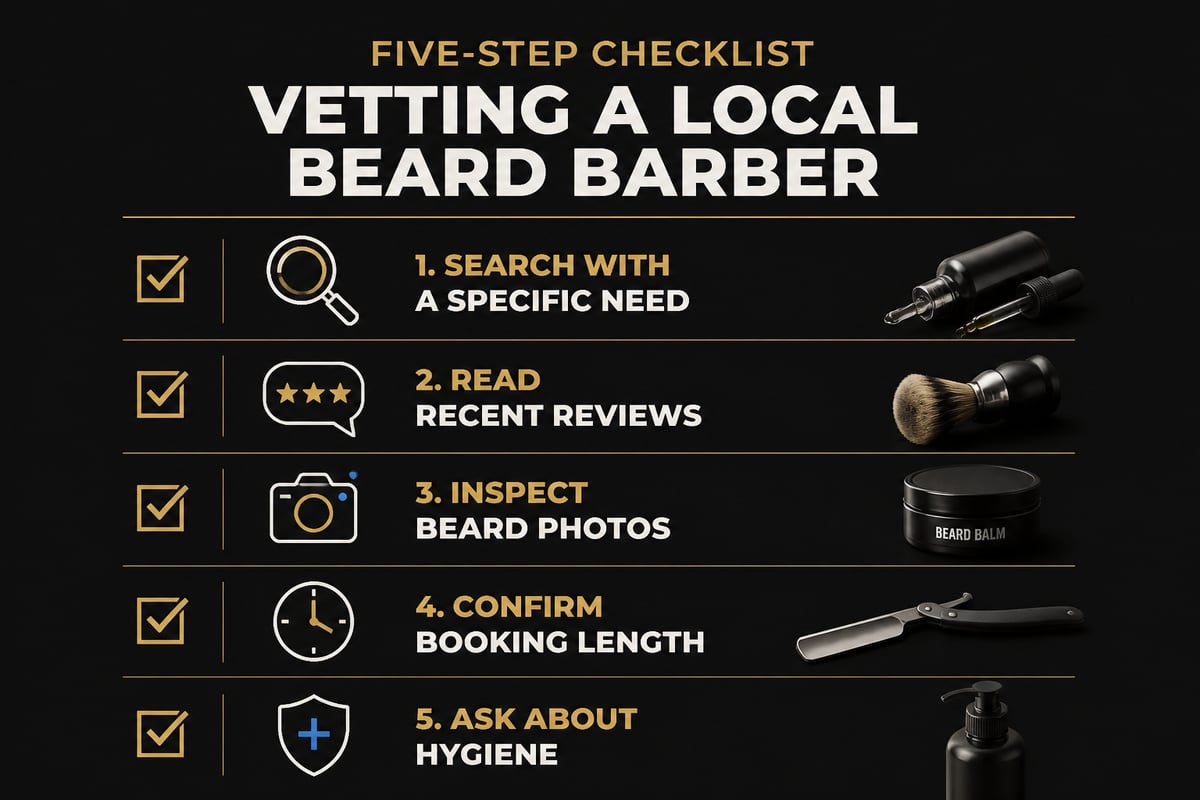
To search for beard grooming near me effectively, add a specific need to your query, check recent reviews and look at photos of finished beards before you book.
Try these search variations, because each one surfaces a different type of shop:
- "Barber beard trim" plus your town or postcode
- "Beard shaping" or "beard sculpting" plus your area
- "Hot towel shave" if you want skin care included
- "Barber for thick beards" or "barber for curly beards" if your texture needs it
Then run each shortlisted shop through a quick filter:
- Read reviews from the last three months. Barbers change, and an old five-star rating tells you little about today's team.
- Look for beard-specific comments. A review that praises a "sharp fade" says nothing about beard work. One that mentions "clean neckline" or "didn't irritate my skin" does.
- Check the photo gallery. Look for close-up beard shots from several angles, not just one flattering profile.
- Confirm the booking method and timing. Beard work with detailing takes longer than a clipper trim, so book a proper slot.
- Note the price range. Prices vary by area, so ask the shop directly instead of trusting a figure you saw elsewhere.
For more ideas on narrowing the field, the Onesociety guide to a good beard barber near me walks through what separates a solid shop from an average one.
Hygiene Checks That Protect Your Skin
A clean barbershop disinfects every tool that touches skin between customers, uses fresh towels and keeps its stations tidy. You should be able to see this happening.
Why does it matter? Your beard area has thousands of tiny openings around each follicle. A dirty comb or razor can carry bacteria from one face to the next, and a nick or a shaving razor can open the skin just enough for infection to start. That risk is small in a well-run shop and real in a careless one.
Regulators spell out the standard. Pennsylvania's rules, for example, require that barbering tools contacting skin, scalp or hair be cleansed, disinfected, rinsed and dried, then stored in a clean, dry, closed container after each patron. The same code requires a freshly laundered towel or fresh paper on the headrest for each customer. Rules differ by region, but the principle holds everywhere: the shop should treat clean tools as non-negotiable.
Use this quick visual check when you walk in:
- Combs and clippers sit in a disinfectant jar or a closed, clean container
- The barber wipes down or replaces the neck strip and cape between customers
- Fresh towels or paper cover the headrest
- Razor blades come out of a sealed pack or are single-use
- Surfaces and floors look swept, not scattered with hair from earlier clients
If a shop fails two or more of these, walk out. Nobody will judge you for it.
Questions to Ask Before the Barber Picks Up the Clippers
Spend two minutes talking before the cut starts, and you will avoid most bad results. A good barber welcomes the conversation.
Ask these, in roughly this order:
- "Can you shape my beard to suit my jaw?" This tells you whether they think about proportion or just follow a guard number.
- "How do you handle my neckline?" A common mistake is setting the line too high. The usual advice is to place it about a finger's width above the Adam's apple, but a good barber adjusts to your anatomy.
- "What do you recommend for my patches?" An honest answer might be "grow it longer for six weeks" instead of "shave it all off".
- "Which guard are you starting with?" Starting longer lets you go shorter. You cannot reattach hair.
- "Will you finish with a cleanse and oil?" This shows whether they care about the skin underneath.
Bring a reference photo if you have a style in mind, but treat it as a direction, not a blueprint. Your growth density and face shape decide what is possible.
Barbershop, Salon or Mobile Groomer: Which Suits You?
Pick a traditional barbershop for hands-on beard shaping, a salon if you also want colour or longer sessions, and a mobile groomer if convenience matters more than a chair.
| Option | Strengths | Watch out for |
|---|---|---|
| Traditional barbershop | Beard shaping, hot towel work, usually walk-in friendly | Quality varies widely between barbers |
| Salon | Longer appointments, colour and treatments | Beard work can be an afterthought |
| Mobile groomer | Comes to you, no travel | Check their kit hygiene and insurance |
| Self-groom at home | Free after the kit cost, instant touch-ups | Needs practice and a steady routine |
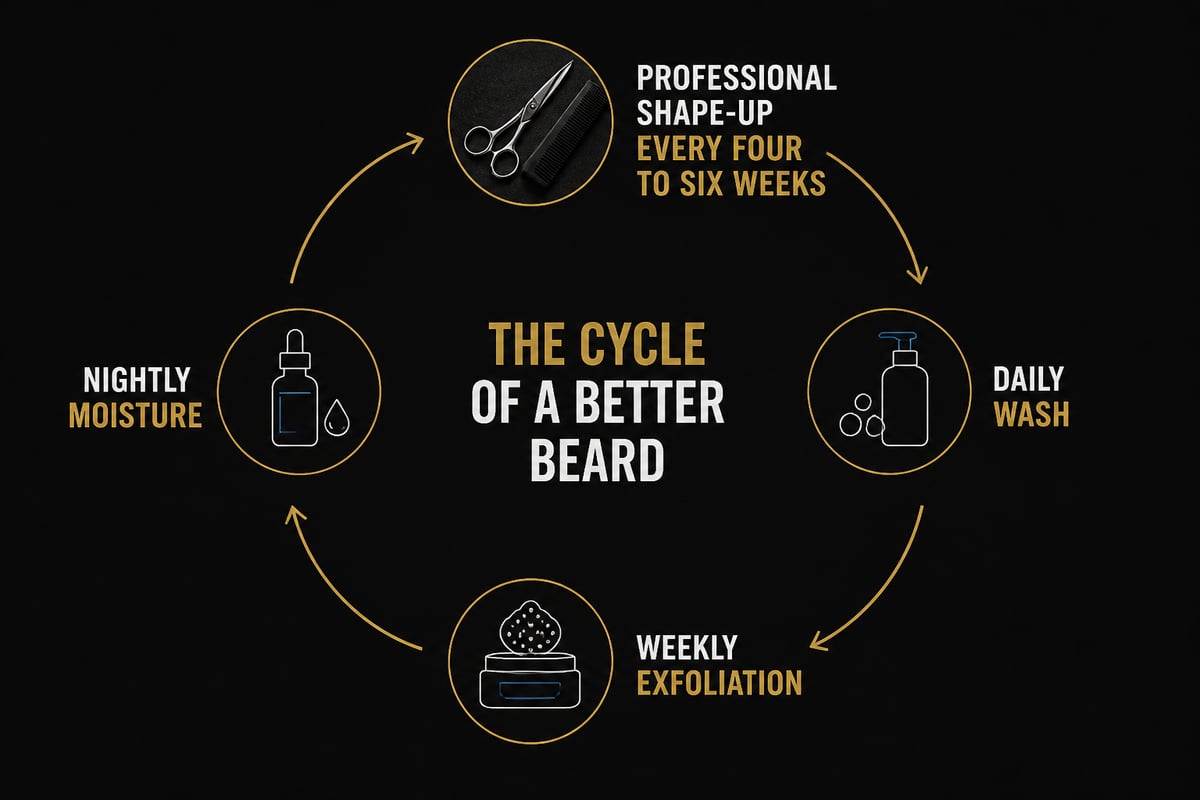
Many men settle on a hybrid: a professional shape every four to six weeks, and a home routine in between. That balance keeps the lines sharp without a weekly bill.
Why Your Beard Needs a Home Routine Between Visits
A barber shapes the beard, but your daily routine decides whether the hair underneath grows thick, soft and itch-free. Without one, a great trim fades fast.
Think about what happens in the days after you leave the shop. Skin oil, sweat and street dust settle into the beard. The skin beneath loses moisture, flakes and itches. You scratch, the follicles inflame and growth slows. Within a week, the sharp lines blur and the beard feels coarse.
The American Academy of Dermatology offers a practical baseline. It recommends washing your face and beard daily with a gentle cleanser suited to your skin type. It also advises moisturiser with SPF 30 or higher during the stubble phase, because short hair gives little protection against sun. If you tend to get ingrown hairs, it suggests gentle exfoliation once or twice a week, followed by moisturiser. Exfoliation lifts dead skin that can otherwise trap emerging hairs and force them to curl inward.
If you shave your neckline between visits, the same source advises changing the razor blade every five to seven shaves. A dull blade drags across the skin, pulls the hair and can raise the odds of irritation.
The Science Behind a Beard Routine That Works
Each step in a beard routine targets one biological job: clean the skin, feed the follicle, seal in moisture and protect the hair shaft. Skip one and the others work harder for less.
Washing removes sebum and debris that clog follicles. A pH-balanced beard shampoo cleans without stripping the skin's natural barrier, which sits slightly acidic. Harsh soap raises the skin's pH, dries it out and triggers flaking.
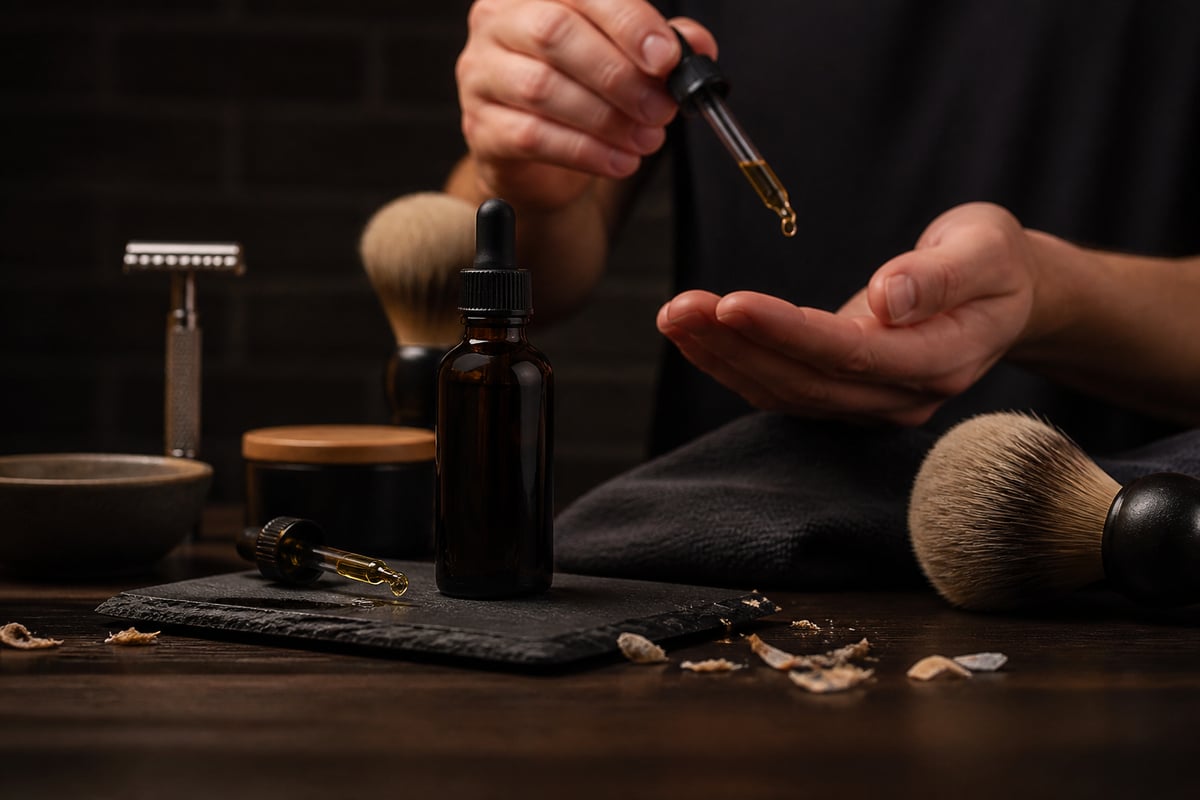
Oiling replaces the lubrication that washing removes. Carrier oils such as jojoba closely resemble human sebum, so skin absorbs them without leaving a heavy film. They soften the hair and reduce friction against the skin, which cuts itch.
Butter and balm seal moisture in. Shea butter contains fatty acids, including oleic and stearic acid, that calm inflammation and form a light barrier on the skin that slows water loss. Beeswax in a balm coats the hair shaft, which adds hold and shields it from wind and cold.
Stimulating blood flow matters too. Follicles draw oxygen and nutrients from the capillaries around them, so massaging a growth formula into the skin supports the environment the hair grows in. No product changes your genetics, and any honest brand will say so. A routine can only help you reach the growth your genes allow, and it can help stop you losing growth to dry, irritated skin.
For a closer look at the basics, the Onesociety post on beard grooming tips covers daily habits in more detail.
Fixing the Real Problem: A Routine You Can Follow for 90 Days
If a trim looks good for three days and then slides, the fix is a structured routine that covers wash, growth support, moisture and protection every day. Beard hair typically grows at a fairly steady rate, so judging a routine takes weeks, not days.
That is the logic behind the 90-Day Beard Challenge. It packs eight formulas into one kit, including a Beard Booster for follicle stimulation and blood flow, a Beard Butter for nightly recovery and deep hydration, a Beard Balm that locks moisture in, and a pH-balanced Beard Shampoo for the reset wash. The range is built around natural ingredients, and the products are designed to feel light rather than greasy.
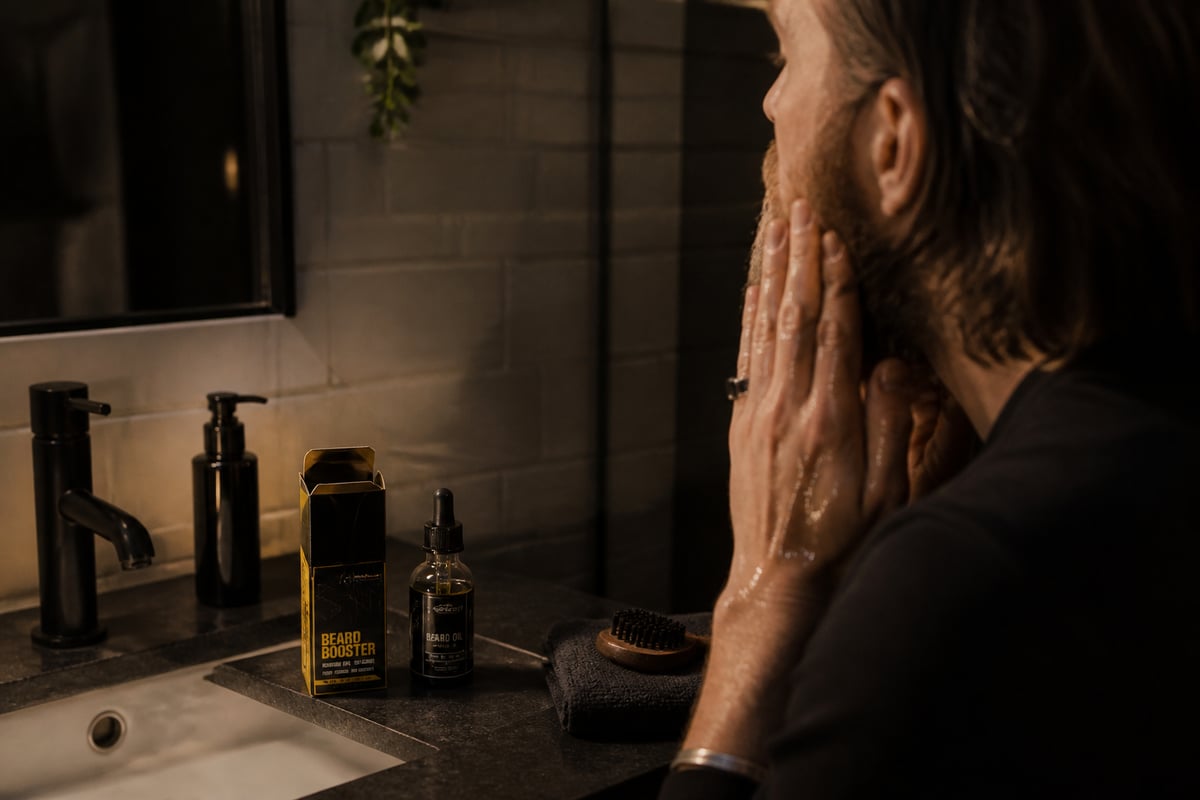
Why does this suit a man who already visits a barber? Because the barber handles shape, and the kit handles the skin and hair quality your barber can only see, not control. Onesociety backs the 90-Day Beard Challenge with a full refund guarantee, and it reports more than 20,000 happy customers. Customers have left Google-verified reviews, including one that reads "Beard felt amazing after first wash". For current pricing, what's included and how the guarantee works, check the 90-Day Beard Challenge product page. You can also find Onesociety's range on the Onesociety Amazon store if you prefer to order there.
One honest note: this approach asks for a few minutes every day. If you want a result with no routine, no product will deliver it.
Pairing Barber Visits With Your Home Routine
Book your barber for shape and clean lines, then use home care to protect the result. The two jobs overlap less than most men expect.
A simple schedule keeps both working:
- Day of the trim: Let the barber shape and cleanse. Skip heavy products for a few hours if your skin feels tender.
- Daily: Wash with a gentle beard shampoo, towel dry and apply a few drops of oil to damp skin and hair.
- Evening: Add butter or balm to seal moisture and tame flyaways.
- Once or twice a week: Exfoliate the skin beneath the beard if you get ingrowns, then moisturise.
- Every four to six weeks: Return to the barber to reset the shape before it grows out of proportion.
If you want to compare what a local professional offers against a home-based approach, the Onesociety article on beard cutting near me breaks down the choices.
Red Flags That Mean Look Elsewhere
Leave if the barber ignores your request, rushes the job or skips basic hygiene. Trust your gut early, because the damage from a bad cut takes weeks to grow out.
Watch for these:
- The barber starts clipping before asking what you want
- Tools come straight from a drawer with no cleaning between customers
- The neckline sits so high that it looks like a second chin
- The barber pushes products you did not ask about and cannot explain what they do
- Your skin burns or stings for hours after, which can signal a dirty blade or harsh aftershave
- Every customer leaves with the same shape regardless of face or growth
A good barber explains choices, adjusts to your feedback and never makes you feel foolish for asking questions. When you find one, stay loyal. A barber who knows your growth pattern gets better results every visit.
FAQ
How often should I get my beard groomed by a barber?
Most men book every four to six weeks to keep the shape tidy. If you run a short, sharp style, you may want a shape-up every two to three weeks. Longer beards can stretch to six or eight weeks, depending on how fast the lines grow out.
Is a beard trim different from a haircut?
Yes. A beard trim involves cheek and neck lines, moustache detailing and often skin care, while a haircut works on scalp hair. Choose a barber who lists beard work as its own service.
Can a barber fix a patchy beard?
A barber can shape around patches so they show less, and can advise whether to grow the beard longer for fuller coverage. No trim creates new follicles. Consistent skin care and patience help the hairs you already have reach their full length.
What should I do if my skin gets irritated after a trim?
Rinse with cool water, avoid scratching and apply a gentle, fragrance-light moisturiser or oil. If redness or bumps persist for several days, see a doctor or pharmacist. Next time, tell the barber about your skin and ask them to check their tools.
Do I need a beard routine if I already visit a barber?
Yes. The barber shapes the outline once a month, but the skin and hair need daily care. Washing, oiling and moisturising keep the beard soft and the skin comfortable between visits.
Before you book anyone, send the shortlist of barbers one message asking how they disinfect tools and whether they specialise in beard shaping, then pick the one who answers clearly. Once the shape is sorted, your daily routine decides how thick and healthy the beard grows underneath it, and the 90-Day Beard Challenge gives you eight natural, science-backed formulas to follow for three months. Onesociety offers a full refund guarantee on the challenge, so you can Accept Challenge and test the routine with the risk on its side.