

Your mustache grows relentlessly, adding 0.3 millimetres of unruly hair every single day. Without proper tools, you're left with uneven edges, scraggly strands poking into your mouth, and a look that screams neglect rather than refinement. The wrong trimming approach transforms your carefully cultivated facial hair into a grooming disaster, undermining months of patient growth and dedicated beard care.
The Critical Problem: Why Generic Scissors Fail Your Mustache
Problem: Most men grab kitchen scissors, craft shears, or repurposed nail clippers when they need to trim their mustache. This approach creates three immediate failures that compound over time.
First, blade geometry matters profoundly. Standard household scissors feature wide, blunt blades designed for paper and cardboard, not the delicate architecture of facial hair. When you position these crude tools near your philtrum, the thick blades obscure your sightline, making precision impossible. You end up guessing where the cut will land, often removing too much hair or creating uneven patches that take weeks to correct.
Second, dull edges crush hair follicles rather than creating clean cuts. This crushing action splits the hair shaft, leaving frayed ends that catch light irregularly and feel coarse against your lips. The damaged follicles also invite ingrown hairs and irritation, particularly along the sensitive skin where your mustache meets your upper lip.
Third, improper scissor size forces awkward hand positions that reduce control. Scissors longer than four inches require wide grip adjustments that introduce tremor and hesitation into each snip.
Agitation: Every botched trim compounds your frustration. You stand at the mirror, trying to salvage uneven patches, only to create new problems with each corrective cut. The mustache you've nurtured for months now looks worse than when you started. Your partner notices the asymmetry. Colleagues ask if you're "still growing that thing out." The psychological toll mounts alongside the physical damage to your facial hair.
Professional barbers report that improper scissor technique causes 70% of at-home grooming failures. You're not alone in this struggle, but that doesn't make the mirror reflection any less disappointing.
Solution: Understanding Scissors for Trimming Mustache
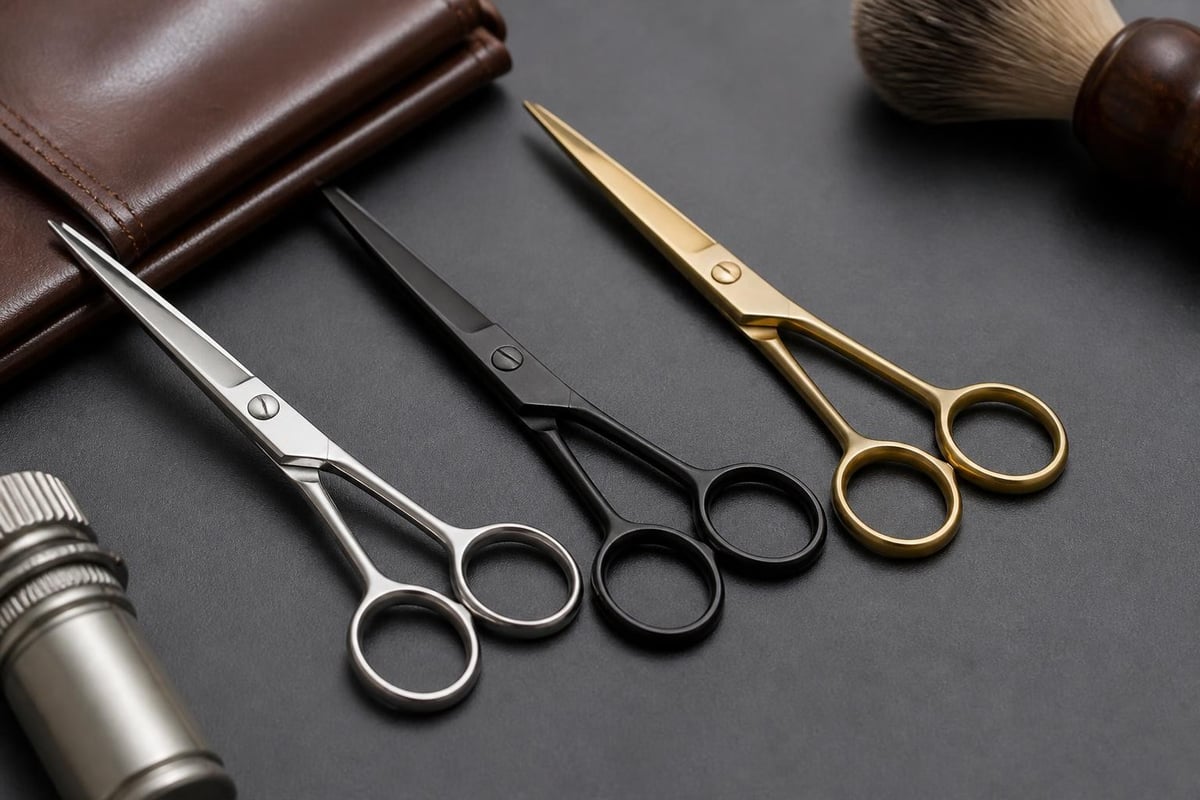
Dedicated mustache scissors solve these problems through three engineering principles: compact blade geometry, surgical-grade sharpness, and ergonomic sizing.
Blade Length and Shape
Professional scissors for trimming mustache measure 3.5 to 4.5 inches total length, with blades spanning 1.5 to 2 inches. This compact footprint provides several functional advantages:
- Visibility: Short blades don't obstruct your view of the trim line
- Manoeuvrability: Tight spaces around the philtrum require compact tools
- Control: Reduced lever length translates finger movements directly to blade action
- Safety: Shorter points reduce the risk of nostril or lip accidents
The blade tips determine your precision ceiling. Rounded tips sacrifice some accuracy but provide safety for beginners. Micro-serrated edges grip individual hairs, preventing slippage during the cut. Straight, sharp points deliver maximum precision for detail work around the cupid's bow and mustache edges.
Steel Quality and Hardness
Blade composition determines longevity and cutting performance. Professional scissors use steel graded on the Rockwell hardness scale.
| Steel Type | Hardness (HRC) | Edge Retention | Sharpening Frequency | Price Point |
|---|---|---|---|---|
| Stainless | 52-54 | Moderate | Every 6 months | Budget |
| Japanese 440C | 58-60 | High | Annually | Mid-range |
| VG-10 | 60-62 | Exceptional | Every 18 months | Premium |
| Damascus | 60-61 | High | Annually | Premium |
Higher hardness ratings maintain sharp edges longer, reducing maintenance intervals. However, harder steel becomes more brittle, requiring careful handling to prevent tip damage.
Handle Ergonomics and Grip
Three handle styles dominate the market, each serving different hand sizes and cutting preferences:
- Offset handles: The thumb ring sits lower than the finger ring, reducing wrist strain during extended sessions
- Crane handles: Extreme offset design drops the thumb ring significantly, ideal for precision cuts that require a bent wrist position
- Symmetric handles: Traditional equal rings suit those who frequently switch hands or prefer a balanced feel
Finger rest extensions provide additional stability but add bulk that some users find cumbersome in tight facial areas.
Mastering the Technique: How to Use Scissors for Trimming Mustache
Problem: Owning quality scissors means nothing without proper technique. The gap between tool ownership and skill mastery traps most men in mediocre results.
Agitation: You've invested in professional-grade scissors, yet your mustache still looks uneven. The tools aren't the limiting factor anymore. Your technique creates the asymmetry, the patches, the regret. Each session at the mirror reinforces bad habits that become harder to unlearn.
Solution: Gillette's mustache shaping guide outlines a systematic approach that transforms random snipping into controlled precision.
The Pre-Trim Preparation
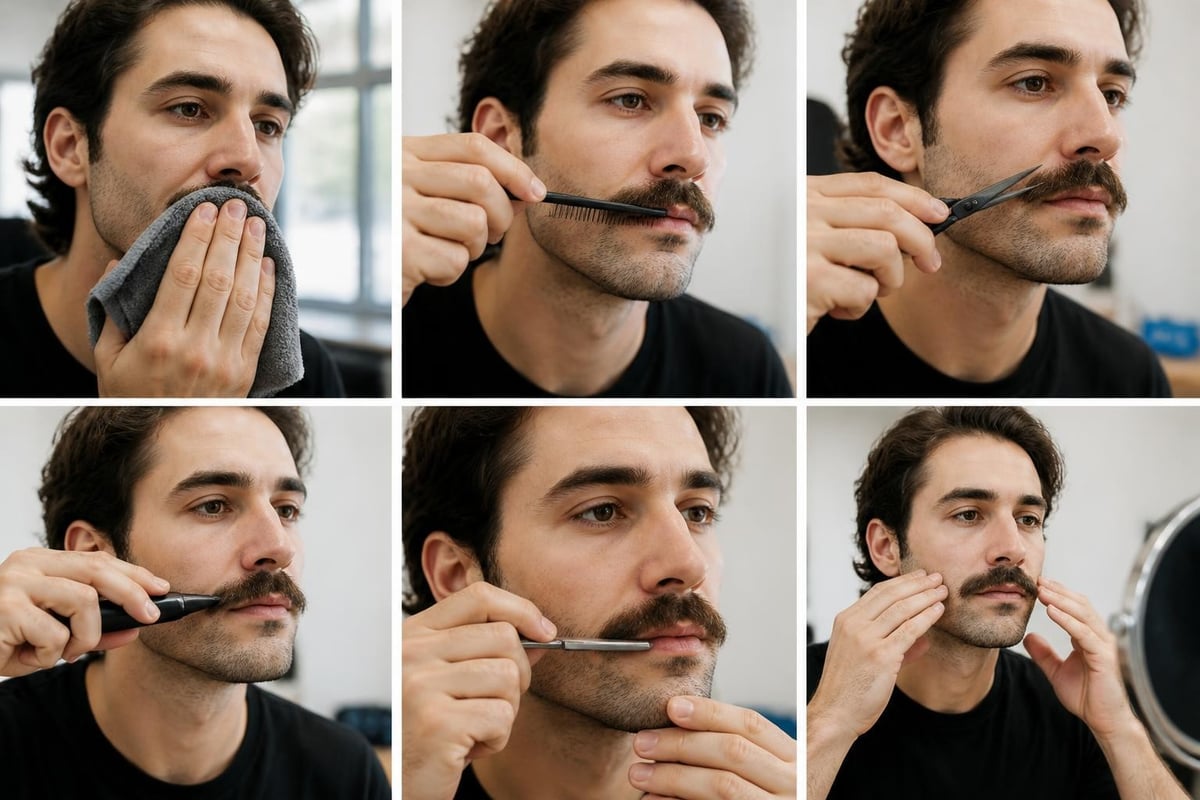
Clean, dry hair cuts more predictably than wet or product-laden strands. Wash your mustache with a pH-balanced cleanser to remove oils, food particles, and styling products. Pat dry completely, then comb through with a fine-tooth mustache comb to detangle and align hair direction.
This preparation reveals the true length and shape of your mustache, eliminating the optical illusions created by clumped or twisted hairs.
The Comb-and-Scissors Method
Position your mustache comb flat against your upper lip, teeth pointing upward. Draw the comb slowly through your mustache, allowing excess length to protrude above the comb's spine. These protruding hairs represent the cutting target.
Hold your scissors for trimming mustache parallel to the comb, blade tips pointing away from your face. Execute short, controlled cuts along the comb line, working from one corner of your mouth toward the centre, then repeating from the opposite corner.
Critical technique points:
- Cut above the comb, never between comb and skin
- Remove less than 2mm per pass; you can always cut more
- Maintain consistent comb angle to ensure even length
- Check symmetry after every three cuts
Detailing the Edges
After establishing overall length, refine the upper and lower borders. The upper border (where mustache meets nose) should follow your natural lip line for a refined appearance. The lower border should rest just above your upper lip, allowing comfortable speech and eating without hair interference.
Work without the comb for edge detail. Pull individual hairs taut between your fingers, then snip perpendicular to the hair shaft. This approach prevents the bevelled edges that occur when cutting at an angle.
Common Technique Errors and Corrections
| Error | Consequence | Correction |
|---|---|---|
| Cutting wet hair | Appears shorter when dried | Always trim completely dry |
| Angling scissors | Creates bevelled, uneven edges | Hold perpendicular to hair shaft |
| Removing too much per pass | Irreversible over-trimming | Maximum 2mm increments |
| Skipping the comb | Inconsistent length | Always use comb as cutting guide |
| Rushing the process | Patches and asymmetry | Allow 10-15 minutes minimum |
Maintaining Your Scissors for Trimming Mustache
Problem: Even premium scissors degrade without proper maintenance. The sharp, precise cuts you enjoyed initially become ragged and unpredictable as months pass.
Agitation: You notice the scissors pulling hairs rather than cutting cleanly. Each trim session takes longer, requires more passes, and delivers worse results. The frustration builds as your expensive tools fail to perform, yet you're reluctant to replace them so soon after purchase.
Solution: Professional scissor maintenance extends tool life and preserves cutting performance through systematic care.
Daily Cleaning Protocol
After each use, wipe blades with a lint-free microfibre cloth to remove hair clippings and skin oils. Open the scissors fully, then fold a small section of cloth over one blade. Pinch the cloth around the blade and draw it from pivot to tip, applying gentle pressure. Repeat for the opposite blade.
This simple wipe-down prevents protein buildup that dulls edges and introduces friction at the pivot point.
Weekly Deep Cleaning
Once weekly (or after every 5-7 uses), perform a thorough cleaning:
- Mix three parts isopropyl alcohol (70% or higher) with one part water
- Dip a cotton bud in the solution
- Clean around the pivot screw, removing accumulated debris
- Wipe blades completely with alcohol solution
- Dry thoroughly with a clean cloth
- Apply one drop of scissor oil to the pivot point
- Open and close scissors ten times to distribute oil
Quartered Steels' maintenance guide emphasises the importance of purpose-formulated scissor oil over generic lubricants. Household oils attract dust and degrade over time, creating gummy residues that impair blade action.
Tension Adjustment
Proper tension allows smooth blade action without play or resistance. Test tension by holding the scissors vertically with one handle in your hand. The opposite blade should swing closed under its own weight, stopping at approximately the halfway point.
If blades swing fully closed, tension is too loose. If they don't move, tension is too tight. Adjust the pivot screw in quarter-turn increments using the appropriate tool (usually a small flat-head screwdriver or proprietary tension key).
Professional Sharpening Intervals
Men's Health's scissor guide recommends professional sharpening every 6-18 months, depending on usage frequency and steel quality. Warning signs that indicate immediate sharpening needs include:
- Hair folding or pushing away from blades rather than cutting
- Audible clicking or grinding during cuts
- Visible nicks or flat spots on blade edges
- Increased hand fatigue during normal use
Avoid DIY sharpening unless you possess professional equipment and training. ShearGenius' sharpening guide warns that improper stone angles or excessive material removal permanently damages blade geometry, often rendering expensive scissors worthless.
Choosing Your First Professional Scissors for Trimming Mustache
Problem: The market offers hundreds of scissor options spanning £10 to £300. Without expertise, distinguishing genuine quality from marketing hyperbole becomes impossible.
Agitation: You've read reviews, compared specifications, and watched YouTube demonstrations, yet confusion persists. Budget options promise "professional results" whilst premium brands justify high prices with technical jargon you don't fully understand. The wrong choice means wasted money and continued grooming frustration.
Solution: Focus on three non-negotiable criteria that separate functional tools from disappointing purchases.
Size Selection
For dedicated mustache work, choose scissors measuring 3.5 to 4 inches total length. Longer scissors suit beard trimming but sacrifice the precision your mustache demands. Shorter craft scissors lack the blade span needed for efficient passes.
If you intend to trim both beard and mustache with a single tool, compromise at 4.5 inches. This length handles beard work adequately whilst remaining manageable for facial detail.
Material Verification
Genuine Japanese or German steel justifies premium pricing through superior edge retention and cutting feel. However, many products claim Japanese steel whilst using lower-grade alloys manufactured elsewhere.
Verify authenticity by:
- Checking for maker's marks etched into the blade
- Researching the manufacturer's country of operation
- Reviewing independent testing results from grooming publications
- Requesting hardness specifications (HRC rating)
Budget Allocation
| Price Range | Expected Features | Suitable For | Lifespan |
|---|---|---|---|
| £10-£25 | Stainless steel, basic finish | Beginners, occasional use | 1-2 years |
| £30-£70 | 440C steel, comfort handles | Regular grooming enthusiasts | 3-5 years |
| £80-£150 | VG-10 or Damascus, premium ergonomics | Daily users, multiple facial styles | 10+ years |
| £150+ | Handmade, exotic materials | Professional barbers, collectors | Lifetime |
Budget-conscious buyers should target the £30-£70 range, which delivers professional performance without the premium associated with collector-grade tools.
Integrating Scissors Into Your Complete Grooming System
Scissors for trimming mustache represent one component of comprehensive facial hair care. The sharpest blades and most refined technique still produce disappointing results when applied to damaged, brittle, or poorly nourished hair.
Your mustache requires daily conditioning to maintain the structural integrity that enables clean cuts. Dry, damaged hair splits and frays under scissor blades, regardless of tool quality. Quality beard oils penetrate the hair shaft, delivering essential fatty acids that increase flexibility and reduce breakage during trimming.
The relationship between healthy hair and successful trimming creates a positive feedback loop. Clean cuts preserve follicle health. Healthy follicles produce stronger, more manageable hair. Stronger hair responds better to styling and maintains shape between trims.
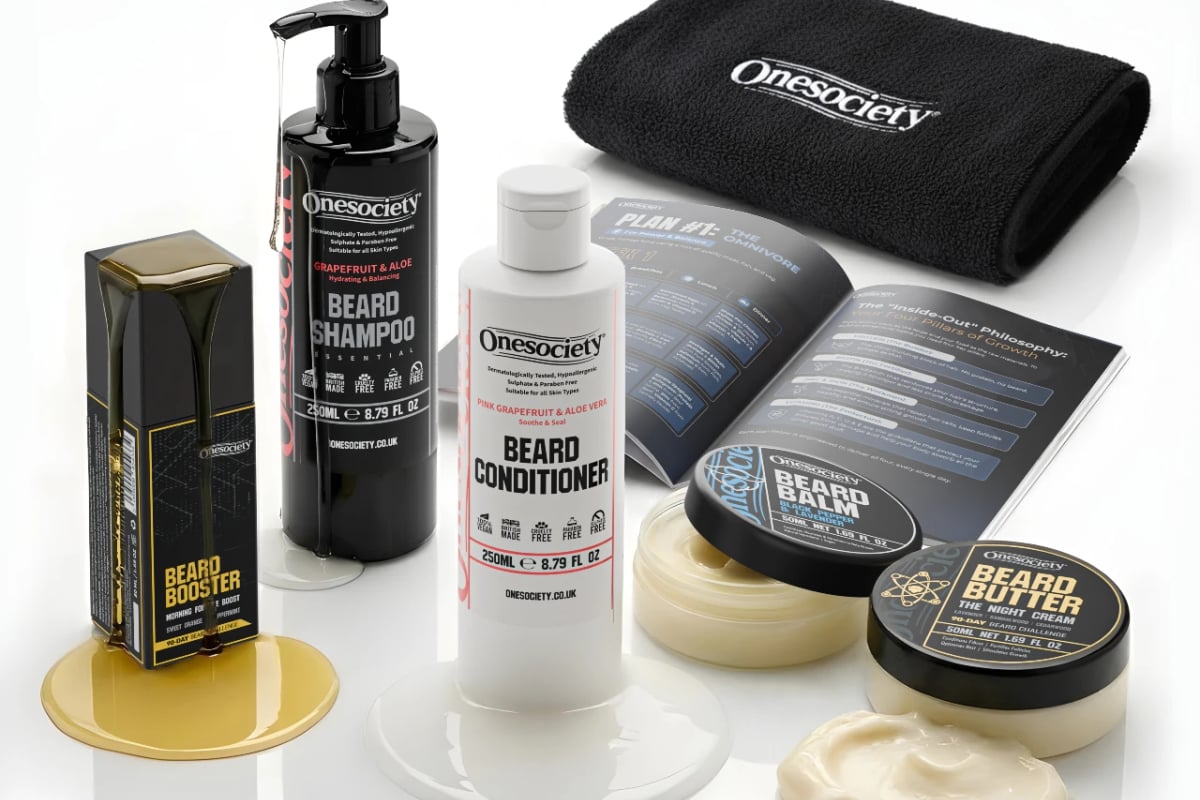
If you're committed to transforming not just your trimming technique but your entire facial hair quality, the 90-Day Beard Challenge provides a comprehensive system. This scientifically formulated kit includes eight targeted formulas that address every stage of facial hair health, from follicle stimulation through protective styling. The Beard Booster increases blood flow to facial hair follicles, promoting the robust growth that gives scissors something substantial to shape. The Hydro-Lock Balm seals moisture into each hair shaft, creating the flexibility that prevents split ends when trimming.

Advanced Techniques for Specific Mustache Styles
Different mustache architectures demand adapted scissor approaches. The handlebar requires different cutting patterns than the chevron, whilst the pencil mustache demands precision that intimidates most home groomers.
The Handlebar Mustache
This dramatic style features long, upward-curled ends that require strategic length management. Trim the central section (above your philtrum) shorter than the extended wings, creating the length differential that enables effective waxing and curling.
Use point-cutting technique on the wing sections, inserting scissor tips into the hair mass at slight angles rather than cutting straight across. This approach removes bulk whilst preserving length, creating the tapered effect that responds best to mustache wax application.
The Chevron Mustache
This full, thick style covers the entire upper lip whilst maintaining a groomed appearance. The cutting challenge involves removing excess bulk without creating thin patches.
Work in horizontal layers, combing small sections downward and trimming protruding hairs level with the desired baseline. Progress from bottom to top, checking density after each layer. The goal is even thickness throughout rather than graduated length.
The Pencil Mustache
Precision defines this thin, sculpted style. Use your scissors' tips exclusively, working with single-hair accuracy along the upper and lower borders.
Mark your desired width with a washable eyeliner pencil before cutting. This visual guide prevents the creeping width expansion that gradually transforms pencil mustaches into chevrons over successive trims.
Troubleshooting Common Trimming Challenges
Even experienced groomers encounter specific problems that resist standard solutions. These scenarios require adapted techniques and sometimes tool modifications.
Problem: Scissors Pull Rather Than Cut
This issue indicates either dull blades or improper blade alignment. Check tension first by adjusting the pivot screw. If pulling persists, professional sharpening becomes necessary.
Temporary workaround: Reduce the amount of hair captured per cut. Instead of working through dense sections, isolate individual hairs or very small groups.
Problem: Uneven Results Despite Careful Technique
Asymmetric facial anatomy (which all humans possess) creates optical illusions that mislead scissor placement. Your face isn't perfectly symmetric, so using identical cutting patterns on both sides produces uneven visual results.
Compensate by focusing on visual balance rather than mathematical precision. Step back from the mirror after every few cuts, assessing overall appearance rather than individual hair positions.
Problem: Coarse, Bristly Texture After Trimming
This texture indicates damaged follicles from crushing rather than clean cutting. Dull scissors or improper cutting angles cause this problem.
Prevention requires sharp blades and perpendicular cuts. Treatment involves intensive conditioning with beard butter to repair follicle damage and soften hair texture during regrowth.
The Role of Complementary Tools
Whilst scissors for trimming mustache serve as your primary shaping instrument, additional tools enhance precision and efficiency.
Mustache Combs
Fine-tooth combs align hair prior to cutting, ensuring consistent length across each pass. Metal combs withstand heat (useful when combined with blow-drying techniques), whilst celluloid combs generate less static.
Comb tooth spacing should match your mustache density. Fine teeth suit thin mustaches, whilst wider spacing works better for thick, coarse facial hair.
Magnification Mirrors
Standard bathroom mirrors don't provide the detail visibility required for precision work. A 5x or 10x magnification mirror reveals individual hair positions, enabling the accuracy that separates professional results from amateur efforts.
Position the magnification mirror to supplement (not replace) your standard mirror. Use it for detail work, then check overall appearance in the regular mirror to ensure balanced proportions.
Trimming Guards
Some grooming specialists recommend guards that attach to scissors, establishing maximum cutting depth. These training wheels help beginners avoid over-trimming whilst developing spatial awareness and muscle memory.
Experienced users generally abandon guards, finding them cumbersome and restrictive. They serve best as temporary learning aids rather than permanent fixtures.
Long-Term Care and Storage
Proper storage protects your investment between uses, preventing damage that degrades performance and shortens tool life.
Store scissors in a dedicated case or leather sheath that shields the blades from impact and moisture. Avoid loose storage in drawers where scissors contact other metal objects that nick edges.
Climate control matters more than most groomers realise. Bathroom humidity promotes rust formation, even on stainless steel. Scissorpedia's storage guides recommend keeping scissors in low-humidity environments, applying a thin oil coating before extended storage periods.
Dedicated tool users often maintain two sets of scissors, rotating them weekly. This approach halves the wear on each set whilst ensuring backup availability if one requires sharpening or repair.
Building Consistent Habits
Tool quality and technique knowledge mean nothing without consistent application. The difference between an impressive mustache and an unkempt mess often comes down to regular maintenance rather than dramatic interventions.
Schedule specific trimming sessions rather than waiting for your mustache to look obviously overgrown. Most men benefit from a 7-10 day trimming cycle, though fast growers may require 5-day intervals.
Track your results through photos. Weekly progress photos reveal gradual improvements in symmetry and technique that daily mirror checks obscure. This visual record also identifies creeping style drift before it requires major corrective action.
Consider your complete grooming ecosystem. The shower products you use, the frequency of washing, the environmental factors you face daily all influence how your mustache responds to trimming. Scissors work best when applied to clean, healthy, well-conditioned facial hair that's been prepared through comprehensive care routines.
The scissors for trimming mustache that you select today will shape your appearance for years to come. Choose tools that match your commitment level, maintain them with professional discipline, and develop the technique through deliberate practice rather than rushed morning sessions. Your reflection deserves that level of dedication.
Scissors for trimming mustache transform facial hair from wild growth into refined style, but only when paired with healthy, well-maintained follicles and comprehensive grooming habits. The precision you achieve with quality tools means nothing if the underlying hair lacks the strength and flexibility to hold shape between sessions. Onesociety combines scientifically formulated, 100% natural grooming products with practical guidance that supports every stage of your facial hair transformation, giving your scissors the foundation they need to create lasting results.