

Your beard deserves precision. A quality beard trimming kit transforms unruly facial hair into a statement of personal style, yet most men approach trimming with inadequate tools and outdated techniques. The difference between a patchy, unkempt appearance and a sharp, professional look often comes down to equipment choice and proper methodology. In 2026, the market offers dozens of trimming solutions, but understanding what genuinely delivers results requires cutting through marketing noise.
The Problem: Why Most Men Struggle with Beard Maintenance
Walk into any barbershop and observe the tools professionals use. They invest in precision equipment because inconsistent trimming creates visible growth patterns that undermine beard aesthetics. At home, men typically grab whatever electric trimmer sits in their bathroom drawer, resulting in uneven length, patchy sections, and frustration.
The Hidden Cost of Inadequate Tools
Poor-quality trimmers pull hair follicles instead of cutting cleanly. This mechanical stress triggers inflammation at the follicle base, disrupting the natural growth cycle your beard follows. When hair gets yanked rather than trimmed, the follicle experiences micro-trauma that can lead to ingrown hairs and temporary growth cessation in affected areas.
The biological consequence:
- Follicular inflammation reduces blood flow to the hair matrix
- Decreased nutrient delivery slows keratin protein synthesis
- Growth rate diminishes by up to 30% in traumatised zones
Many common beard struggles stem from improper trimming technique rather than genetic limitations. Your beard grows at approximately 0.4mm per day, meaning just three days of poor maintenance creates noticeable unevenness.
What Defines a Quality Beard Trimming Kit
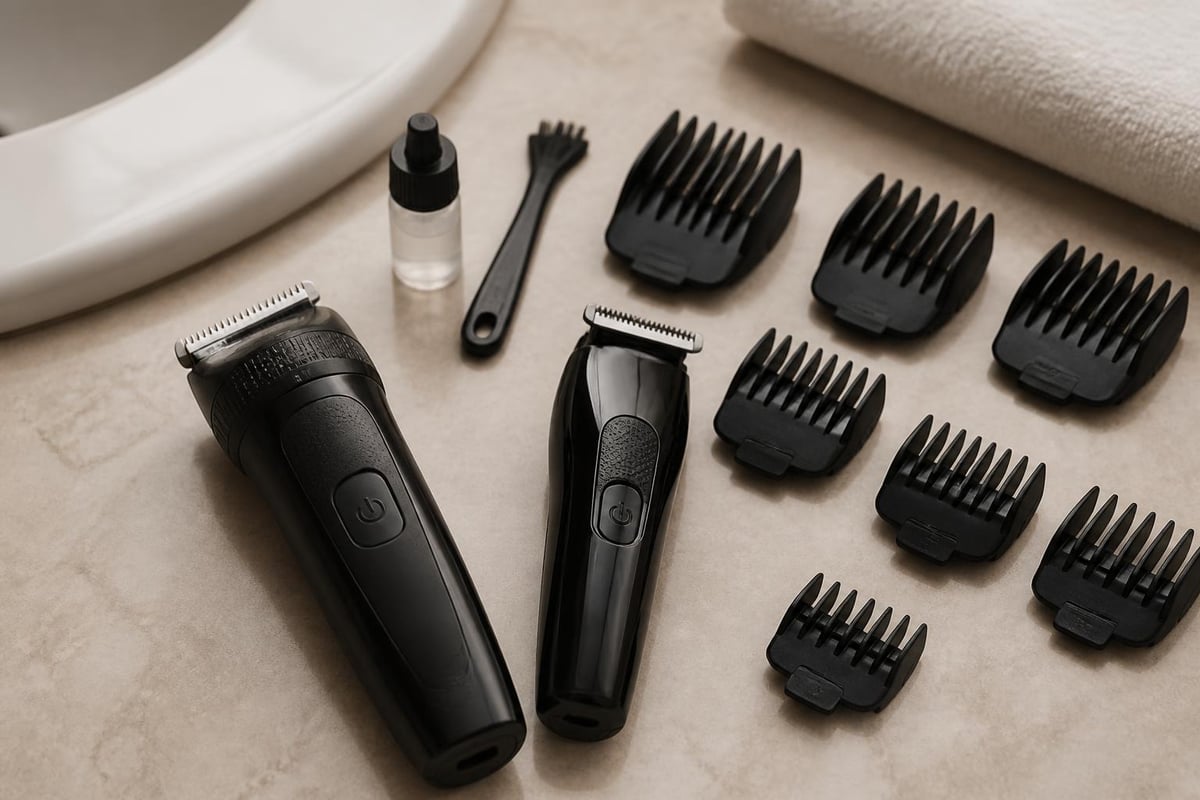
A comprehensive beard trimming kit contains specific components that address different facial zones and styling requirements. Generic single-device solutions cannot accommodate the varied density patterns across your jaw, neck, and cheek areas.
Essential Components You Need
| Component | Function | Why It Matters |
|---|---|---|
| Adjustable Trimmer | Primary length control | Different zones require different guard lengths |
| Precision Detailer | Edge definition | Creates sharp neckline and cheek boundaries |
| Multiple Guards | Length variation | Enables fading and graduated styles |
| Cleaning Brush | Maintenance | Removes trapped hair that dulls blades |
| Blade Oil | Preservation | Reduces friction and extends blade life |
The trimmer motor determines performance consistency. Rotary motors deliver 6,000-8,000 cuts per minute, whilst linear magnetic motors achieve 10,000+ cuts with reduced heat generation. Heat damages both the blade coating and your hair cuticle, making motor type a critical specification rather than a minor detail.
Blade Technology That Actually Works
Titanium-coated blades resist corrosion from skin oils and cleaning products, maintaining edge sharpness 40% longer than uncoated stainless steel. Self-sharpening blade systems use counter-cutting action where opposing blades grind against each other during operation, continuously honing the cutting edge.
According to Consumer Reports' evaluation of beard trimmers, blade quality outweighs battery life as the primary performance indicator. A dull blade operating at full power still crushes hair fibres instead of slicing cleanly.
Selecting Your Ideal Beard Trimming Kit
Match your kit to your beard characteristics, not to marketing promises. A thick, coarse beard requires higher torque motors and wider-tooth guards, whilst fine hair benefits from precision cutting systems with tighter tolerances.
Assessment Framework
Evaluate these factors before purchasing:
- Beard density (follicles per square centimetre)
- Hair diameter (fine, medium, or coarse)
- Growth pattern direction (affects grain cutting)
- Desired maintenance frequency (daily touch-ups vs weekly sessions)
- Style complexity (clean lines vs natural fade)
Dense beards with 150+ follicles per cm² need robust motors rated at 7+ watts. Lower-powered devices stall when encountering high-density zones, creating uneven results that necessitate multiple passes. Each additional pass increases follicular trauma.
T3's comprehensive 2026 guide highlights how premium kits incorporate multiple motor speeds. Variable speed control lets you reduce power for detail work around the moustache whilst maintaining full torque for bulk removal along the jawline.
Corded Versus Cordless Systems
Cordless convenience comes with performance compromises. Lithium-ion batteries deliver consistent voltage until nearly depleted, then power drops sharply. This sudden performance degradation mid-trim creates obvious length inconsistencies.
Battery considerations:
- Charge cycles before degradation (500+ cycles preferred)
- Runtime at full power (60+ minutes minimum)
- Charge time (quick charge technology matters)
- Voltage maintenance curve (gradual vs sharp drop-off)
Corded systems maintain unwavering power but restrict movement. Hybrid kits offering both corded and cordless operation provide flexibility without sacrificing performance when precision matters most.
Mastering Trimming Technique
Equipment quality means nothing without proper technique. Your beard grows in multiple directions across different facial zones, requiring adapted approaches for each area.
The Three-Zone Method
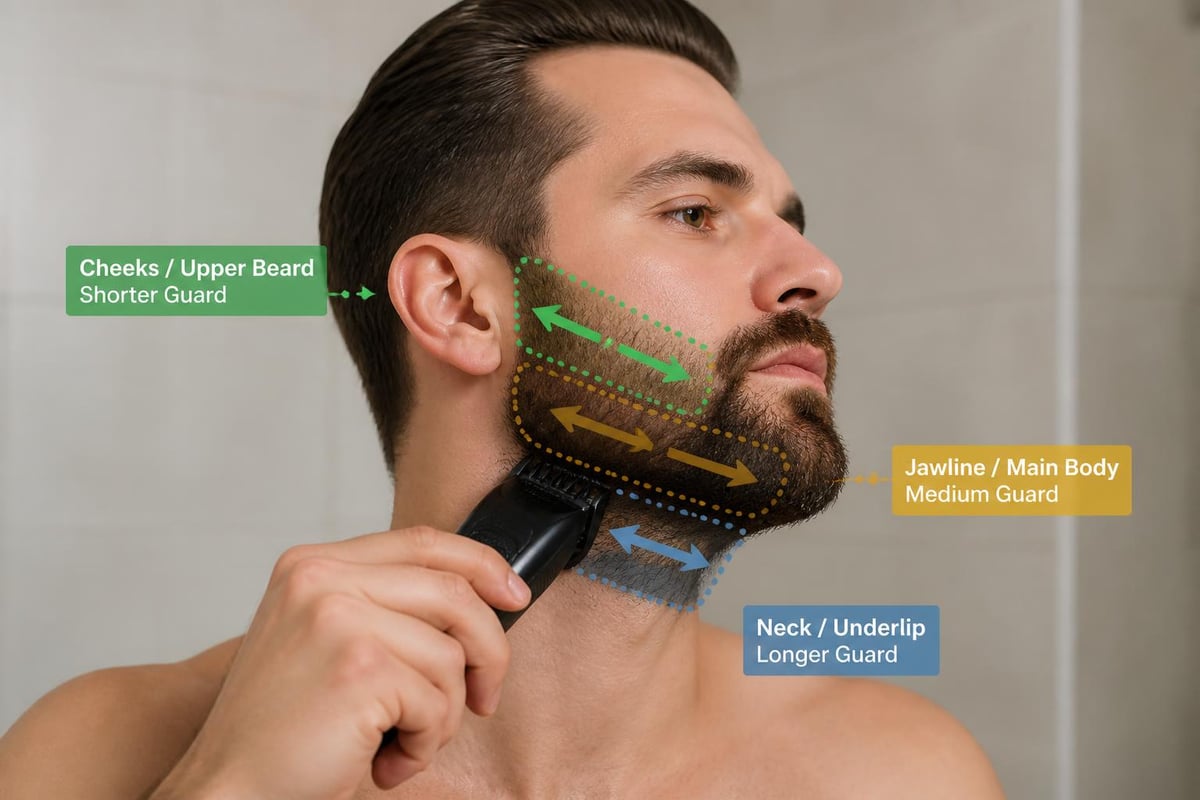
Divide your beard into distinct zones that receive individual attention:
Zone 1: Cheeks and upper beard Start with your longest guard setting and work downward with the grain. The cheek hair typically grows at a downward angle, so trim from sideburn to jawline using smooth, overlapping strokes.
Zone 2: Jawline and main beard body This high-density area requires the most careful attention. Work against the grain for closer cutting, using medium guard lengths. The jawbone creates a natural contour that your trimmer must follow precisely.
Zone 3: Neck and underlip Use shorter guards for the neck area to create definition. The neckline should curve naturally, not cut straight across. Start two fingers above your Adam's apple and curve upward toward your ears.
Creating Sharp Lines
Edge definition separates amateur trims from professional results. Use your precision detailer without a guard for these areas:
- Upper cheek line (maintain natural curve, don't create artificial straight lines)
- Neckline (two-finger rule from Adam's apple)
- Moustache boundary (just above lip line)
- Sideburn integration (gradual fade into hair)
Forbes' analysis of professional trimming tools emphasises that removable blade heads enable closer work near sensitive areas. Fixed-head designs create safety gaps that prevent truly crisp lines.
Maintenance Protocols That Extend Kit Lifespan
A quality beard trimming kit represents significant investment. Proper maintenance extends functionality for years whilst maintaining cutting precision.
Post-Use Cleaning Routine
Hair and skin cells accumulate between blade teeth during every use. This organic matter harbours bacteria that can transfer to your skin during subsequent trims, potentially triggering folliculitis (follicle inflammation).
After each session:
- Remove guard attachments and rinse under running water
- Use the cleaning brush to dislodge trapped hair from blade teeth
- Apply two drops of blade oil across the cutting surface
- Run the trimmer for 10 seconds to distribute oil evenly
- Wipe excess oil with a clean cloth
Blade oil contains mineral oil and anti-corrosion additives that create a protective barrier against oxidation. Skip this step and moisture promotes rust formation that degrades cutting edges within months.
Storage Conditions Matter
Temperature fluctuations and humidity accelerate component degradation. Store your kit in a consistent environment away from direct moisture sources like showers.
| Storage Factor | Impact | Optimal Range |
|---|---|---|
| Temperature | Battery chemistry stability | 15-25°C |
| Humidity | Corrosion prevention | Below 60% RH |
| Light exposure | Plastic component UV damage | Drawer or case |
| Dust exposure | Motor bearing contamination | Enclosed space |
Integrating Trimming with Comprehensive Beard Care
Trimming shapes your beard, but follicle health determines growth quality and density. The most precisely trimmed beard appears thin and patchy if underlying follicular function underperforms.
The Growth-Maintenance Cycle
Healthy beard follicles progress through three phases: anagen (active growth), catagen (transition), and telogen (rest). Approximately 85% of your follicles exist in active growth at any time, whilst the remaining 15% rest. This cycle explains why you continuously shed beard hairs whilst maintaining overall density.
Supporting optimal follicle function requires:
- Adequate protein intake (keratin synthesis demands amino acids)
- Sufficient blood flow to follicular dermal papilla cells
- Proper hydration (hair shafts contain 10-13% water)
- Protection from environmental oxidative stress
Natural ingredients deliver these requirements without synthetic additives that may disrupt hormone signalling. Jojoba oil's molecular structure closely mimics sebum, allowing deep penetration to the follicle base where it reduces inflammation and supports cellular energy production in the hair matrix.
When you commit to structured beard development, combining precision trimming with scientifically-formulated growth support accelerates results dramatically. The 90-Day Beard Challenge packages eight complementary formulas that address every aspect of follicular function, from initial blood flow stimulation through protective barrier maintenance. This systematic approach transforms sparse growth into dense, healthy facial hair by optimising the biological processes that determine beard quality.


Pre-Trim Preparation
Never trim a dry beard. Dry hair creates additional resistance against blades, increasing motor strain and reducing cutting precision. The hair cuticle (outer protective layer) contracts when dry, making each strand slightly thicker and harder to cut cleanly.
Wash your beard 10 minutes before trimming using a pH-balanced cleanser. This removes sebum buildup and temporarily swells the hair shaft, making cutting easier. Pat partially dry, leaving slight dampness that helps hair stand away from skin for more even cutting.
Advanced Techniques for Complex Styles
Basic maintenance keeps your beard neat, but advanced techniques enable creative styling that reflects personal aesthetics.
Gradient Fading
Professional fades transition gradually from longer beard body to shorter neck areas. This requires systematic guard changes across subtle zones.
Execute a three-level fade:
- Start with your longest guard on the main beard body
- Switch to a guard 2-3mm shorter for the lower jaw area
- Use a guard 3-4mm shorter for the upper neck region
- Blend transition zones with upward flicking motions
Each transition zone should span 1-2cm vertically to create smooth graduation rather than obvious length steps.
Sculpted Cheek Lines
Natural cheek lines follow genetic patterns, but deliberate sculpting creates sharper definition. Identify your natural growth boundary, then use your precision detailer to carve a subtle enhancement 2-3mm below this line.
Avoid extreme sculpting that creates artificial-looking straight lines. The cheek line should curve naturally from your sideburn to the corner of your moustache, following your facial bone structure.
CNN's tested recommendations note that LED-illuminated trimmers significantly improve edge work accuracy by eliminating shadows that obscure the exact cutting line.
Troubleshooting Common Issues
Even quality equipment produces suboptimal results when technique falters or maintenance lapses occur.
Uneven Length After Trimming
Cause: Inconsistent pressure against skin or working against varied growth directions without adjusting angle.
Solution: Use light, consistent pressure. Let the trimmer do the work rather than pressing hard. Check growth direction by running your hand through your beard and noting resistance patterns, then adjust your trimming angle accordingly.
Skin Irritation Post-Trim
Cause: Dull blades crushing hair follicles instead of cutting cleanly, or excessive passes over the same area.
Solution: Sharpen or replace blades when you notice increased pulling sensation. Limit yourself to two passes maximum over any zone. Apply a natural post-trim conditioner containing anti-inflammatory compounds like bisabolol (from chamomile) to soothe irritated follicles.
Battery Performance Degradation
Cause: Lithium-ion chemistry naturally degrades through charge cycles, particularly when stored at full charge in warm environments.
Solution: Store cordless trimmers at 40-60% charge when not in regular use. Avoid leaving the device on the charger continuously, as constant trickle charging accelerates capacity loss.
Evaluating Kit Performance Over Time
A beard trimming kit should maintain consistent performance across years of regular use. Establish baseline metrics when new, then monitor for degradation indicators.
Track these performance markers:
- Time required to trim your full beard (should remain constant)
- Number of passes needed for even cutting (increases indicate dulling)
- Motor sound (bearing wear creates higher-pitched whining)
- Battery runtime between charges (lithium degradation reduces capacity)
- Blade heat generation (increased friction from wear)
TechRadar's hands-on testing methodology provides useful benchmarks for assessing whether your current kit still performs adequately or requires upgrade consideration.
Building Your Complete Grooming System
A beard trimming kit handles length maintenance but represents just one component of comprehensive facial hair care. Integration with quality growth and conditioning products creates synergistic benefits that exceed the sum of individual practices.
The complete beard care approach combines mechanical shaping through trimming with biological support through targeted nutrition delivery. When you trim precisely then immediately apply follicle-optimising formulas, you capitalise on enhanced absorption while cuticles remain slightly raised from cutting action.
Consider your entire morning routine as an interconnected system rather than isolated steps. Each element either supports or undermines the others based on sequence and product chemistry compatibility.
Investment Versus Value Analysis
Premium beard trimming kits command prices exceeding £150, whilst budget options sell for under £30. This 5x price differential reflects substantial quality variations that impact long-term cost-effectiveness.
Cost Per Trim Calculation
Calculate actual value by dividing purchase price by expected lifespan in trim sessions:
Budget kit: £30 ÷ 100 trims = £0.30 per session
Premium kit: £150 ÷ 1000 trims = £0.15 per session
The premium option delivers better results at half the long-term cost. Factor in the intangible value of superior performance and the calculation favours quality investment even more decisively.
Warranty and Support Considerations
Reputable manufacturers back quality products with multi-year warranties covering motor failure and blade defects. This protection matters because trimmer motors endure significant mechanical stress that can trigger premature failure in poorly manufactured units.
Budget brands typically offer 12-month warranties at most, whilst premium manufacturers provide 3-5 year coverage. Extended warranty availability signals manufacturer confidence in component longevity.
Selecting and maintaining a quality beard trimming kit establishes the foundation for long-term facial hair success, but combining precision trimming with scientifically-optimised growth support delivers transformative results. At Onesociety, we've developed comprehensive beard care solutions using 100% natural ingredients backed by rigorous research, ensuring every product supports your follicular health whilst you perfect your trimming technique. Explore our complete range of beard oils, balms, and conditioning treatments designed to complement your grooming routine and unlock your beard's full potential.