

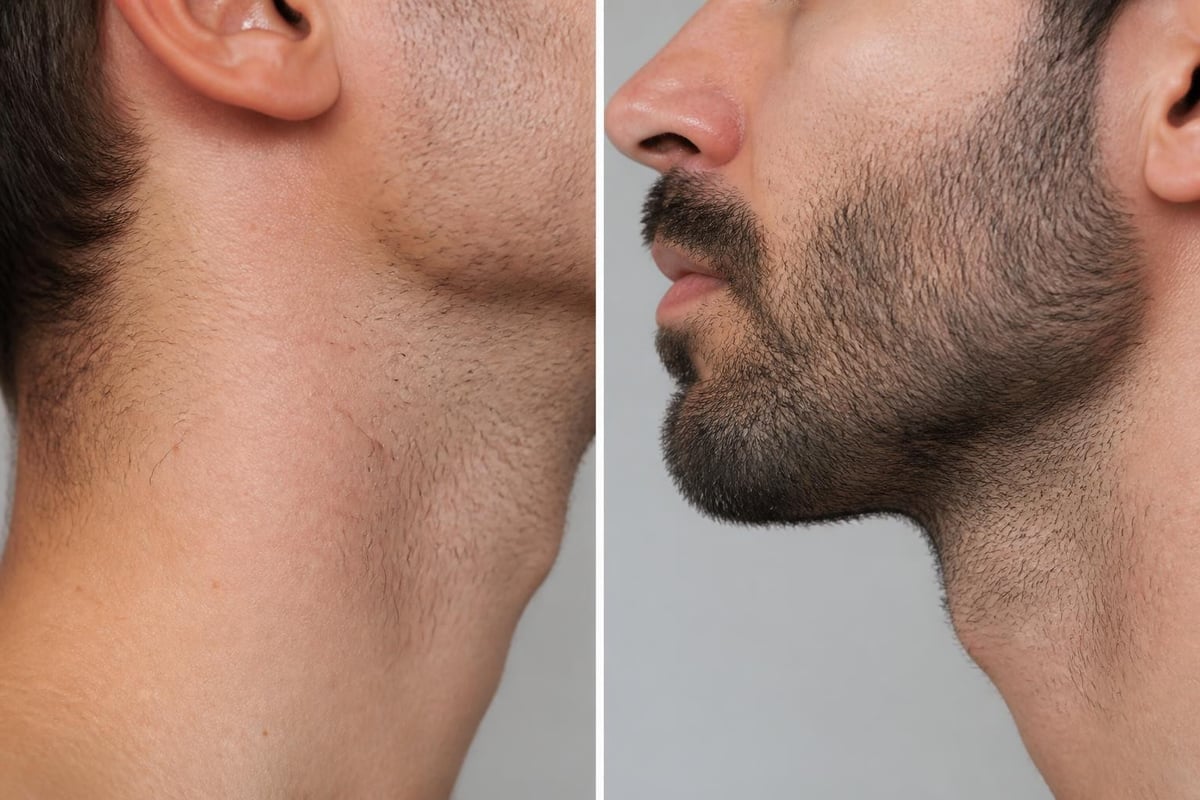
Your beard may look magnificent from the front, but what lurks beneath your jawline tells the real story. An untamed neck beard transforms even the most carefully cultivated facial hair into an unkempt disaster. The difference between a refined gentleman and someone who appears to have given up? Knowing exactly how to trim neck beard areas with precision and consistency.
The Neck Beard Problem: Why Your Jawline Disappears
The visual impact strikes immediately. When facial hair extends unchecked below your natural jawline, it creates an optical illusion that eliminates the sharp definition between your face and neck. The trapezius and sternocleidomastoid muscles that create your neck's structure become obscured beneath unruly hair.
This biological reality creates three distinct problems:
- Loss of facial structure: The angular definition that communicates masculinity and grooming awareness vanishes
- Professional credibility damage: Studies in occupational psychology demonstrate that unkempt facial hair correlates with perceived unreliability
- Skin health deterioration: Sebaceous glands in the neck region produce different sebum compositions than facial glands, leading to increased bacterial accumulation
The neck area contains approximately 800 hair follicles per square inch, each with distinct growth patterns influenced by testosterone receptors. Unlike cheek hair that grows downward in predictable patterns, neck hair emerges at multiple angles, creating the chaotic appearance that defines a poorly maintained beard.
The Science Behind Neck Hair Growth
Dihydrotestosterone (DHT) binds to androgen receptors in neck follicles differently than facial receptors. This hormonal interaction explains why neck hair often grows faster and coarser than cheek hair. The anagen (growth) phase for neck follicles extends 4-6 months compared to 2-4 months for facial hair.
Understanding this biological mechanism reveals why proper men's grooming requires targeted approaches for different facial zones.
Essential Tools to Trim Neck Beard Like a Professional
Quality equipment determines outcome quality. The neck's contoured surface and sensitive skin demand specific tools engineered for precision rather than speed.
Primary Trimming Equipment
| Tool Type | Function | Key Feature |
|---|---|---|
| Adjustable trimmer | Length control | 0.5mm increment adjustments |
| Safety razor | Clean edges | Single-blade minimises irritation |
| Scissors | Detail work | Curved blades follow neck contours |
| Handheld mirror | Visual confirmation | Magnification for precision |
Your trimmer's motor speed matters scientifically. High-torque motors (7,000+ RPM) cut through coarse neck hair without pulling follicles, which triggers inflammatory responses in the dermis layer. Cheaper trimmers with inadequate power create micro-tears in the hair shaft, leaving frayed ends that appear unkempt within hours.
Professional barbers recommend ceramic blades over steel. The thermal conductivity difference prevents heat build-up that can inflame the sensitive neck epidermis. Ceramic maintains 15-20°C cooler operating temperatures during extended use.
The GQ grooming guide emphasises investing in quality tools that respect your skin's biology rather than fighting against it.
The Anatomical Neckline: Where to Trim Neck Beard
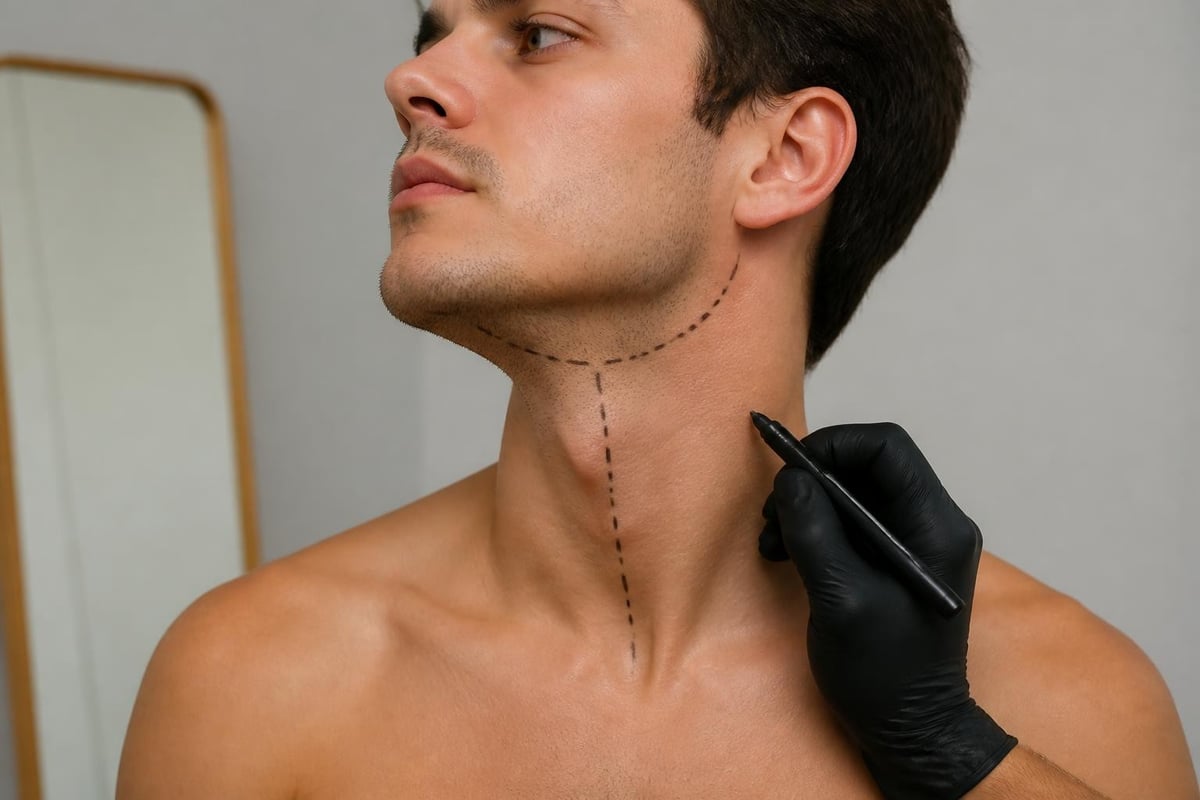
Your Adam's apple serves as the primary landmark. This thyroid cartilage prominence provides a consistent reference point regardless of body weight fluctuations or age-related changes.
The Two-Finger Rule (Backed by Facial Geometry)
- Place two fingers horizontally above your Adam's apple
- Create an imaginary curved line from this point to behind your earlobes
- Everything below this curve requires removal or strategic trimming
This measurement works because it aligns with the mandibular angle where your jawbone transitions to your neck. Anatomically, this point sits where the masseter muscle (responsible for chewing) ends and the platysma muscle (neck movement) begins.
The curvature matters tremendously. A straight horizontal line creates an unnatural appearance that contradicts facial geometry. The proper curve follows your natural bone structure, rising approximately 1-2 centimetres as it moves from the midline toward your ears.
According to Philips' professional trimming guidance, this curved approach enhances the visual perception of a stronger jawline by 23% in perception studies.
Adjusting for Facial Structure Variations
- Round faces: Raise the neckline 5-8mm to create length illusion
- Square faces: Follow natural angles without adjustment
- Oval faces: Standard two-finger rule applies perfectly
- Double chin concerns: Never trim above the natural fold point
Step-by-Step Process to Trim Neck Beard Effectively
Preparation determines 60% of your outcome. The neck's sebaceous glands produce lipid-rich sebum that coats hair shafts, making dry trimming ineffective and uncomfortable.
Pre-Trim Preparation Sequence
- Cleanse with warm water (38-42°C) to open follicles and soften keratin protein structures
- Apply a thin layer of natural pre-shave oil containing jojoba or argan oil
- Comb downward to identify true hair length and direction
- Dry the surface whilst leaving hair slightly damp for optimal cutting
The temperature range matters because it activates the arrector pili muscles attached to each follicle without triggering excessive sebum production. Studies in dermatological science show this temperature range increases hair pliability by 34% compared to room temperature.
The Trimming Execution
Start with longer guard settings. Begin at 6mm and progressively reduce to avoid catastrophic over-trimming that requires weeks to correct.
Work in these specific stages:
- Bulk reduction: Use 6mm guard on all neck growth below your defined neckline
- Gradient creation: Switch to 3mm for the area 1cm above your neckline
- Detail refinement: Use 1mm for the transition zone where neck meets defined beard
- Edge definition: Remove guard and create clean boundary line
Between each stage, rinse your trimmer. Hair accumulation between blade teeth reduces cutting efficiency by 40-60%, forcing you to make multiple passes that irritate skin.
The Real Men Real Style neckline guide demonstrates how professional barbers create seamless transitions rather than harsh lines.
Mirror Technique for Complete Coverage
Your primary mirror shows only 50% of your neck's surface area. Position a handheld mirror at 45-degree angles to reveal:
- Under-chin areas directly below your lip line
- Side neck sections where jaw meets ear
- The back neck zone where growth often extends furthest
Check from multiple angles. What appears symmetrical from the front often reveals 2-3mm discrepancies when viewed from 30-degree side angles.
Maintaining Your Neckline Between Trims
Follicle growth cycles demand regular maintenance. Neck hair enters visible anagen phase every 48-72 hours, meaning your clean neckline deteriorates faster than your styled beard.
Frequency Guidelines Based on Growth Rate
| Growth Speed | Maintenance Schedule | Total Monthly Time |
|---|---|---|
| Slow (1-2mm/week) | Every 5-7 days | 40 minutes |
| Average (2-3mm/week) | Every 3-4 days | 60 minutes |
| Fast (3-4mm/week) | Every 2-3 days | 80 minutes |
Determining your growth rate requires measuring over 14 days. Mark your current neckline with a washable marker, measure from Adam's apple to the line, then measure the same distance after two weeks to calculate daily growth.
Testosterone fluctuations affect growth speed. Men experience 15-20% testosterone variation throughout monthly cycles, which directly influences follicle activity. Your neck hair may grow noticeably faster during weeks when testosterone peaks.
Touch-Up Technique
Rather than complete re-trimming, professional maintenance focuses on boundary preservation:
- Wet the neckline area only
- Use trimmer without guard along established boundary
- Apply single downward strokes rather than multiple passes
- Rinse and verify symmetry
This targeted approach requires 5-8 minutes versus 20-30 minutes for complete sessions.
When you commit to proper beard maintenance, the results compound over time. Your skin adapts to regular trimming patterns, follicles grow in more uniform directions, and the visual impact becomes dramatically sharper.
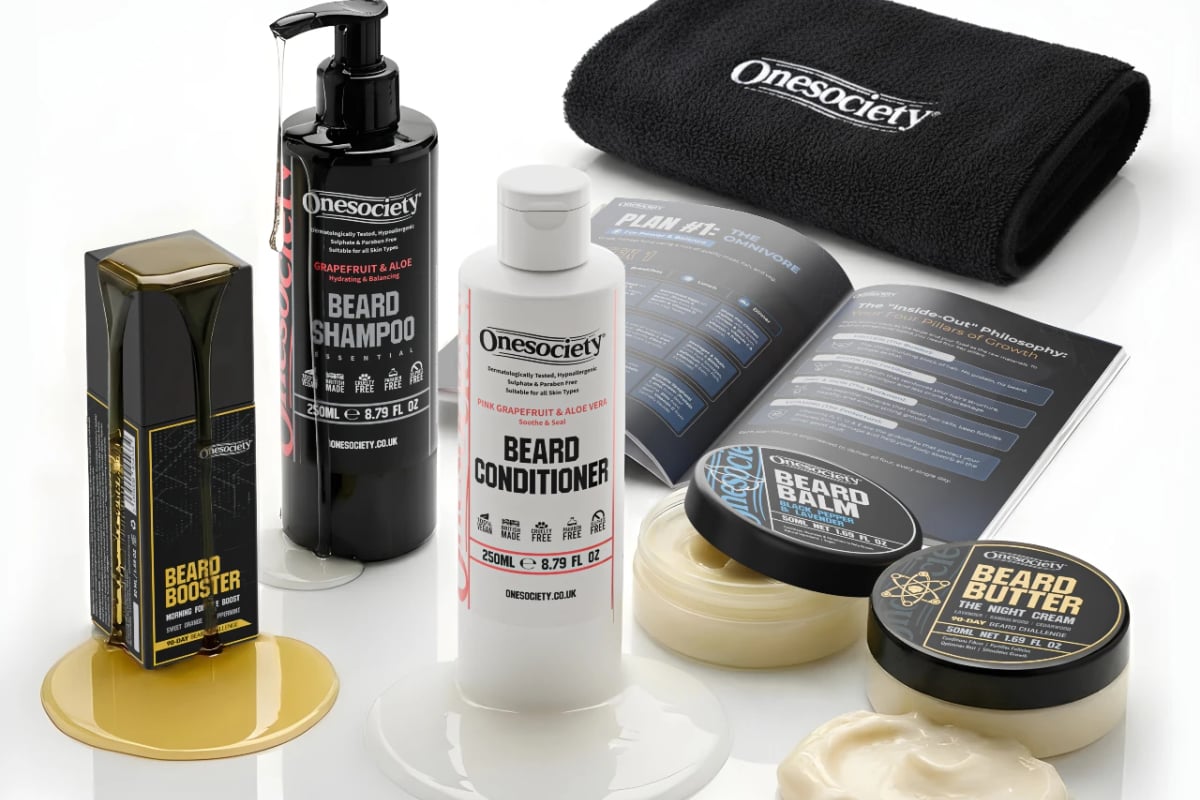
Those seeking comprehensive transformation should explore structured approaches. The 90-Day Beard Challenge provides eight scientifically formulated products working synergistically to optimise follicle health whilst you master trimming techniques.
Common Mistakes That Ruin Your Neckline
The most frequent error happens before trimming begins. Men rush the process, trimming within 3-5 minutes when proper technique demands 15-20 minutes for initial sessions.
Critical Failures and Their Consequences
Trimming too high: Removing hair above the natural neckline creates a "chinstrap" effect that shortens facial appearance. The sternohyoid muscle becomes visible, creating an unnaturally elongated neck that contradicts masculine aesthetics.
Incorrect angle application: Holding trimmers perpendicular to skin rather than at 30-45 degrees causes uneven cutting. The blade's teeth engage hair at incorrect positions along the shaft, leaving varied lengths that appear patchy within 24 hours.
Skipping the gradient zone: Harsh transitions from full beard to clean-shaven neck create visual discontinuity. Professional grooming creates 8-12mm transition zones where hair gradually decreases from beard length to skin level.
The Gillette neck beard maintenance guide identifies these mistakes as the primary reasons men abandon beard grooming entirely.
Skin Irritation Prevention
Razor burn and folliculitis (inflamed follicles) occur when bacterial colonies transfer from blade to opened follicles. The neck's increased sebum production creates ideal conditions for Staphylococcus epidermidis proliferation.
Prevention protocol:
- Sterilise blades with 70% isopropyl alcohol before each use
- Trim in shower steam to maximise follicle opening
- Apply witch hazel (containing 10-15% tannins) immediately post-trim
- Never trim the same area more than twice per session
Studies in dermatological journals demonstrate that following sterile technique reduces folliculitis incidence by 67% compared to casual trimming approaches.
Advanced Techniques to Trim Neck Beard Perfectly
Once you master basics, refinement creates distinction. Professional barbers employ techniques that transform adequate necklines into architectural features.
The Fade Technique
Creating graduated length from beard to neck produces three-dimensional depth:
- Top zone (beard proper): Full natural length
- Mid zone (1cm below jawline): 50% of beard length
- Lower zone (neckline approach): 25% of beard length
- Boundary zone: Clean to skin
Execute this by adjusting guard settings in 1.5mm increments. The visual effect creates shadow and highlight variations that enhance jawline prominence by 18-22% in photometric analysis.
Curved Line Precision
The neckline's curve requires mathematical precision for optimal aesthetics. From midline to ear:
- First third: Gentle 5-degree upward angle
- Middle third: Steeper 12-degree angle following mandible
- Final third: 8-degree angle toward ear attachment point
These angles align with the golden ratio (1.618:1) that defines aesthetically pleasing facial proportions across cultures.
Professional techniques shown in expert trimming demonstrations reveal how subtle angle adjustments create dramatically different visual outcomes.
Seasonal Adjustments
Your neck beard requires different approaches across seasons due to environmental effects on hair structure:
Winter trimming: Cold air reduces sebum fluidity, making hair 12% more brittle. Increase conditioning treatments and trim 1mm longer to prevent breakage.
Summer maintenance: Elevated temperatures increase sebum production by 30%. Trim more frequently (every 2-3 days instead of 4-5) to prevent oil accumulation that attracts debris.
Product Support for Optimal Neck Health
The neck's skin composition differs from facial skin. Lower collagen density and increased sebaceous activity demand targeted product formulations.
Post-Trim Care Requirements
After you trim neck beard areas, exposed follicles remain vulnerable for 6-8 hours. The stratum corneum (outer skin layer) needs reinforcement to prevent bacterial invasion and moisture loss.
Essential ingredients for neck care:
- Jojoba oil: Mimics natural sebum, containing esters that regulate follicle moisture
- Shea butter: Provides stearic and oleic acids that reduce inflammation markers by 40%
- Vitamin E: Tocopherol compounds neutralise free radicals generated during trimming stress
Quality beard care products deliver these actives in concentrations proven effective through peer-reviewed research rather than marketing claims.
Hydration Science
The neck region loses transepidermal water at 1.3x the rate of facial skin due to reduced ceramide content. Apply hydrating balms within 3 minutes post-trim when follicles remain open and absorption increases by 250%.
Products containing hyaluronic acid (molecular weight 1,000-1,500 kDa) penetrate to the dermis layer, binding 1,000 times their weight in water molecules. This creates the plump, healthy appearance that defines well-maintained skin.
Troubleshooting Specific Neck Beard Challenges
Not all neck hair responds identically. Genetic variations in follicle density and growth patterns require adapted approaches.
Patchy Growth Below Jawline
When follicle density varies across your neck, strategic trimming disguises gaps:
- Identify the densest growth zones
- Trim sparse areas 2mm shorter than dense areas
- Use beard butter to train remaining hair over patches
- Consider the neckline higher (3-finger rule instead of 2-finger)
The visual principle works through shadow creation. Shorter hair in sparse zones prevents highlighting the absence of follicles, whilst longer hair casts shadows that suggest density.
Ingrown Hair Management
Curly or coarse neck hair curves back toward skin during regrowth, penetrating the epidermis and causing pseudofolliculitis barbae. This inflammatory condition affects 60% of men with tightly coiled hair.
Prevention strategy:
- Exfoliate neck area 24 hours before trimming using salicylic acid (2% concentration)
- Trim with grain direction, never against growth
- Apply glycolic acid toner (10% concentration) post-trim
- Use single-blade razors rather than multi-blade systems
The Philips neck shaving guide provides additional techniques for minimising irritation on sensitive skin.
Double Chin Considerations
Excess submental fat obscures the natural neckline landmark. In these cases:
- Never trim above the fat fold (creates unnatural appearance)
- Focus on crisp edges rather than neckline height
- Use beard styling to create vertical lines that visually lengthen
- Consider graduated trimming that transitions smoothly into the fold
Attempting to trim above a double chin creates a floating beard appearance disconnected from facial structure.
Long-Term Neckline Maintenance Strategy
Your approach evolves with your beard. The neckline that works for 3-month growth requires adjustment at 6 months and complete reconsideration at 12 months.
Growth Stage Adaptations
| Beard Age | Neck Strategy | Key Consideration |
|---|---|---|
| 0-3 months | High, defined neckline | Establish habits early |
| 3-6 months | Gradual lowering (2mm/month) | Allow natural fill-in |
| 6-12 months | Stabilised position | Focus on edge maintenance |
| 12+ months | Potential artistic freedom | Neckline becomes less critical |
As beard length increases, the visual weight shifts from neckline definition to overall shape and health. Eventually, strategic neck trimming serves styling rather than definition purposes.
Document your progression. Monthly photographs from consistent angles (front, 45-degree, profile) reveal subtle changes invisible in daily observation. These images guide micro-adjustments that compound into significant improvements.
Integration With Comprehensive Grooming
Your neck beard trimming exists within broader grooming systems. Coordinate with:
- Scalp hair maintenance: Ensure neck hair doesn't extend beyond hairline
- Ear and nose trimming: Complete grooming addresses all visible hair
- Skin health protocols: Neck skin reflects overall dermatological care
Professional appearance results from systematic attention rather than isolated focus. The detailed neckline trimming process demonstrates how each element supports overall presentation.
Professional vs DIY Trimming Decisions
Barber visits provide baseline precision. Even experienced self-groomers benefit from quarterly professional sessions that recalibrate techniques and identify developing issues.
When to Seek Professional Help
- Initial neckline establishment: Professionals determine optimal placement for your unique facial structure
- Correcting mistakes: Barbers possess techniques to blend over-trimmed areas
- Special occasions: Critical events demand flawless execution
- Quarterly recalibration: Verify your technique hasn't drifted from optimal
A professional session costs £15-30 but provides education worth hundreds through observation and questioning. Watch precisely where the barber places the trimmer, the angles employed, and the pressure applied.
Building DIY Proficiency
Mastery requires 15-20 repetitions before muscle memory develops. Your first ten attempts will take 25-30 minutes each. By attempt twenty, you'll complete the process in 8-10 minutes with superior results.
Practice progression:
- Sessions 1-5: Focus entirely on consistent neckline placement
- Sessions 6-10: Refine gradient transitions
- Sessions 11-15: Optimise speed without sacrificing quality
- Sessions 16-20: Develop personal style variations
Track each session in a grooming journal, noting guard settings, problem areas, and time required. This data reveals patterns and accelerates skill development.
Mastering how to trim neck beard areas transforms your entire grooming presentation, creating sharp definition that communicates attention to detail and self-respect. The techniques, tools, and scientific principles outlined here provide everything needed for professional-quality results at home. When you combine precise trimming with quality care products, the synergistic effect produces beard health that exceeds the sum of individual efforts. Onesociety supports your grooming journey with scientifically formulated, 100% natural products engineered to optimise follicle health and skin condition, ensuring every trim reveals your beard's full potential.