

Rosemary beard oil can support a fuller-looking beard, but it will not conjure hair where your follicles have no instruction to grow it. The best evidence comes from scalp research, where rosemary oil and a standard treatment produced comparable hair-count results over six months, and that gives beard growers a reasonable, if cautious, reason to try it.
So where does that leave you if your cheeks look patchy and your patience is wearing thin? Somewhere between hope and homework. This guide sorts the biology from the marketing, shows you how to apply the oil, and explains where a full routine beats a single bottle.
Does Rosemary Beard Oil Actually Work?
Rosemary beard oil works best as a supporting actor: it can improve the conditions around a follicle, but it cannot rewrite your genetics. Your beard density depends mainly on how your follicles respond to androgens, and no essential oil changes that wiring.
The most useful study sits on the scalp, not the chin. A randomised comparative trial put 100 people with androgenetic alopecia into two groups, 50 using rosemary oil and 50 using 2% minoxidil, for six months. Neither group showed a significant change in hair count at three months, while both showed a significant increase at six months.
That second finding matters. The same trial found no significant difference in hair count between the rosemary-oil and minoxidil groups at either assessment. Rosemary kept pace with a well-known treatment on hair count.
Scalp itching also rose from baseline in both groups, and it was more frequent with minoxidil than with rosemary oil. So rosemary looked gentler on this measure, though irritation remained possible.
Two honest caveats apply. The trial studied scalp hair, not facial hair. And Medical News Today notes that further research is needed before anyone treats rosemary oil as a proven hair-growth remedy. Treat the result as encouraging, not conclusive.
How Might Rosemary Oil Support Facial Hair?
Rosemary oil likely supports facial hair through two routes: better circulation around the follicle and a calmer, healthier skin environment. Both remain proposed mechanisms rather than proven ones, so hold them loosely.
Here is the reasoning behind each.
- Circulation. Rosemary contains compounds such as 1,8-cineole and camphor. Applied with a massage, they produce a warming, mildly stimulating effect on the skin. More blood flow means more oxygen and nutrients reaching the follicle bulb, the structure that builds each hair.
- Antioxidant protection. Carnosic acid and rosmarinic acid, two of rosemary's main active compounds, neutralise free radicals. Oxidative stress damages follicle cells, so reducing it helps protect the tissue that grows your hair.
- Anti-inflammatory action. Rosmarinic acid also dampens inflammatory signals in skin. Less inflammation under the beard means less itch, flaking and breakage from scratching.
Notice what is missing from that list: a direct effect on dihydrotestosterone.
Is Rosemary a DHT Blocker?
No, rosemary is not a proven DHT blocker. Lab-based and animal research has suggested that rosemary extracts may interfere with the enzyme that converts testosterone into DHT, but no human trial has shown that a few drops of oil on your jaw does the same.
That distinction matters for beards. DHT drives facial hair growth, so blocking it would be counterproductive on the chin, however useful it might be on a receding scalp. Rosemary oil's job in a beard routine is nourishment and circulation, not hormone manipulation.
What Is the 3 Month Beard Rule?
The 3 month beard rule says you should leave your beard alone for roughly twelve weeks before judging it. Facial hair grows in cycles, and many follicles sit dormant while their neighbours sprint ahead, so patchy areas at week three often fill in by week twelve.
This lines up neatly with the rosemary evidence. Remember that the scalp trial showed no significant change at three months, but a significant increase at six. If you apply rosemary beard oil for ten days, see nothing and quit, you have stopped before the experiment began.
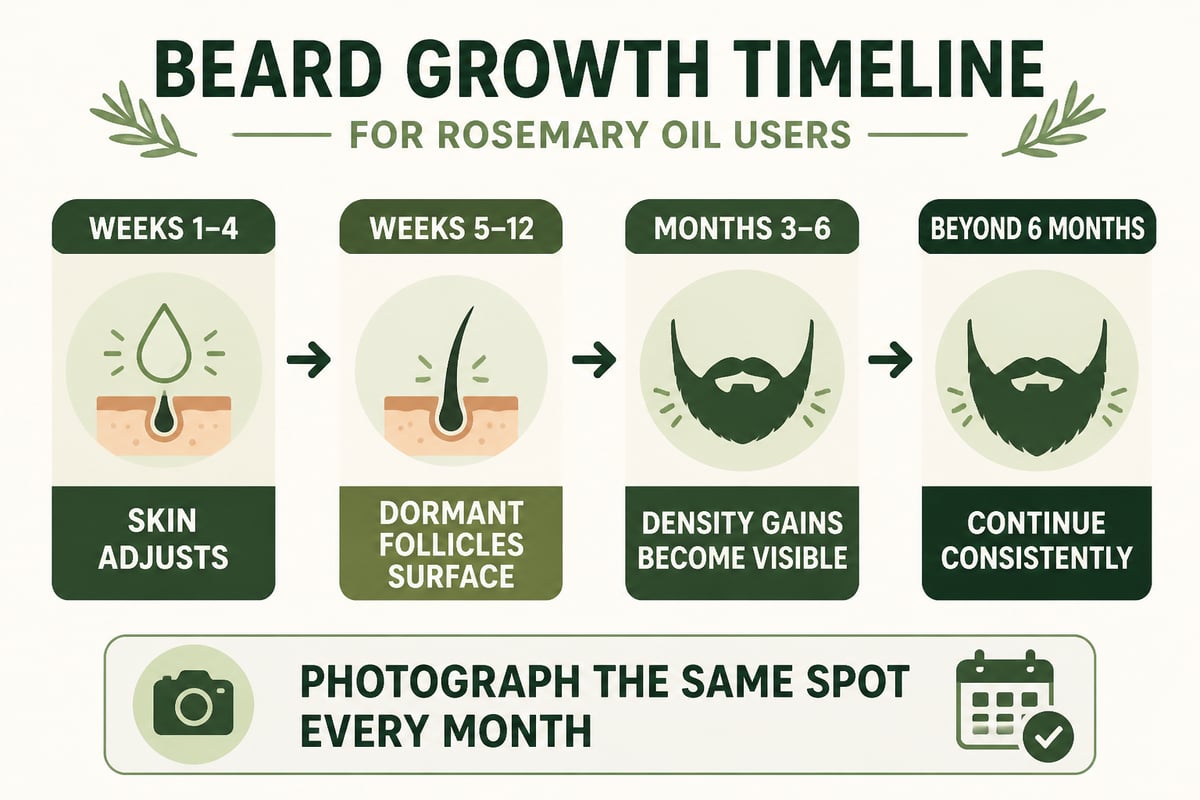
A sensible timeline looks like this:
- Weeks 1 to 4: Skin adjusts. Expect less itch if your beard was dry, but little visible change.
- Weeks 5 to 12: Dormant follicles begin to surface. Resist the razor, even on the neckline mess.
- Months 3 to 6: Density gains become measurable. Compare photos taken in the same light.
The Problem Most Beard Growers Face
Most men who reach for rosemary beard oil share one problem: a beard that looks thin, patchy or dull, and no clear idea why.
Often the cause is not the follicle at all. Dry, tight skin under the beard cracks and itches. You scratch. Hairs snap off at the surface, and the beard that was growing looks like it stalled. Dry, itchy skin beneath facial hair is a common beard complaint, and the American Academy of Dermatology offers guidance on managing it.
Now agitate that picture for a moment. You are three weeks in, the mirror shows gaps, and every itch tempts you to trim "just the messy bits". Each trim resets your progress. Each flake on your collar erodes your confidence. Skin trouble such as irritation and acne can also build under a beard, and inflamed skin does not grow hair well.
The solution starts with the skin. Feed it, protect it, and give follicles a stable environment to work in.
Why a Single Essential Oil Is Not Enough
A single essential oil cannot carry a whole beard routine because beard growth depends on hydration, skin barrier health, cleansing and circulation working together.
Think of it as soil. You can add the best fertiliser in the world, but if the soil is parched and compacted, little grows. Here is what each layer does:
| Routine step | Biological job | Why it matters for growth |
|---|---|---|
| Carrier oil (jojoba, argan) | Mimics sebum and seals in moisture | Reduces dryness that causes breakage |
| Rosemary oil | Antioxidant and circulation support | Protects follicle cells and encourages blood flow |
| Shea butter | Fatty acids reduce inflammation and soften skin | Calms itch so you stop scratching and snapping hairs |
| pH-balanced shampoo | Removes buildup without stripping the skin barrier | Keeps pores clear and prevents irritation |
| Balm | Forms a protective film over hair | Locks in moisture and shields against wind and cold |
Pure rosemary essential oil also sits at the wrong concentration for direct use. Undiluted, it can irritate skin, which is the opposite of what a struggling beard needs.
The Solution: A Complete System Built Around Rosemary
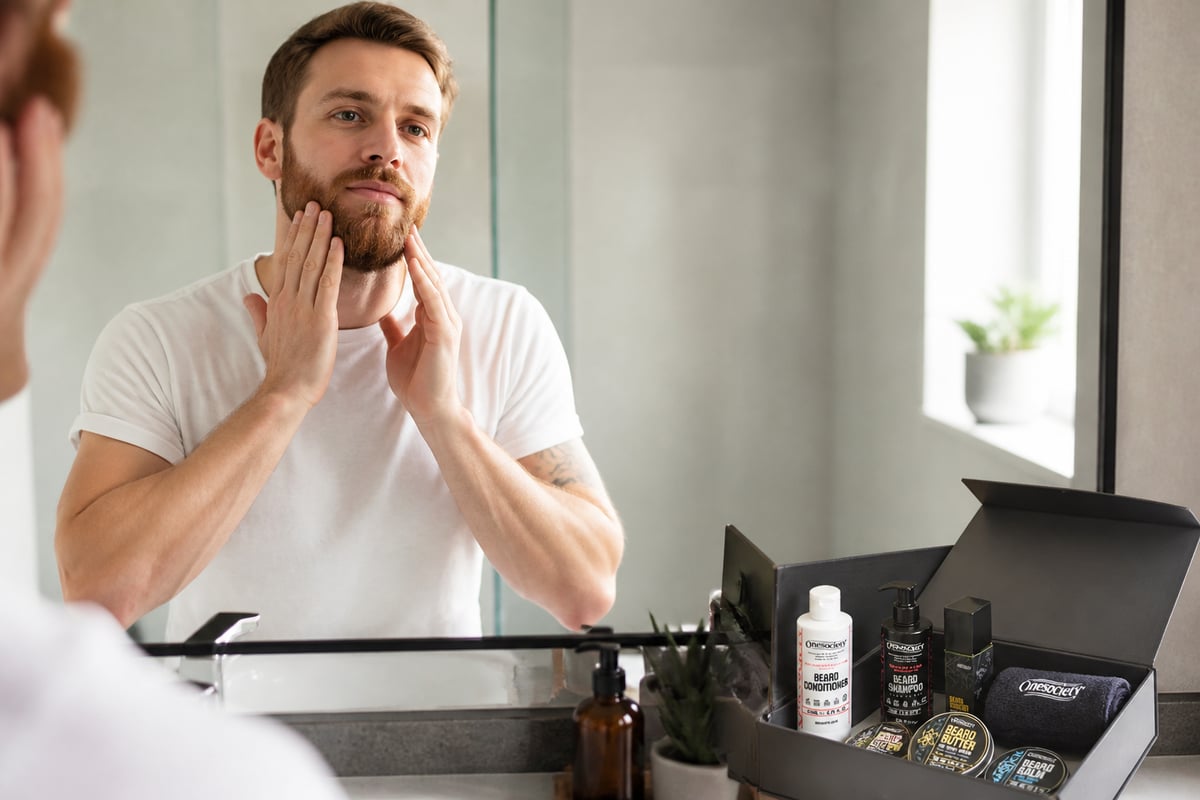
A complete beard system delivers rosemary alongside the moisturising, cleansing and protective steps that let it work. That is the logic behind the 90-Day Beard Challenge from Onesociety, a single kit that packs eight formulas into one routine.
Inside the box you get a Beard Booster for follicle stimulation and blood flow, a Beard Butter for nightly recovery and deep hydration, a Hydro-Lock Beard Balm for protection, and a pH-balanced Beard Shampoo as the cleansing reset. Each step has a defined job, so you are not guessing which product does what.
Why does the kit suit a rosemary-focused routine? The 90-day window matches the timeline the research implies. If rosemary needs months, not weeks, to show a difference, a structured programme with a refund guarantee gives you the runway to find out without gambling your money. You can buy the 90-Day Beard Challenge here, or browse the same range on the OneSociety Amazon store if you prefer to order there.
If you want a single bottle first, the best beard growth oil is a sensible starting point. Prefer a thicker texture? The rosemary and cinnamon beard butter uses shea butter, whose fatty acids reduce inflammation and soften coarse hair, and the matching beard balm seals that moisture in during the day.
How to Use Rosemary Beard Oil Step by Step
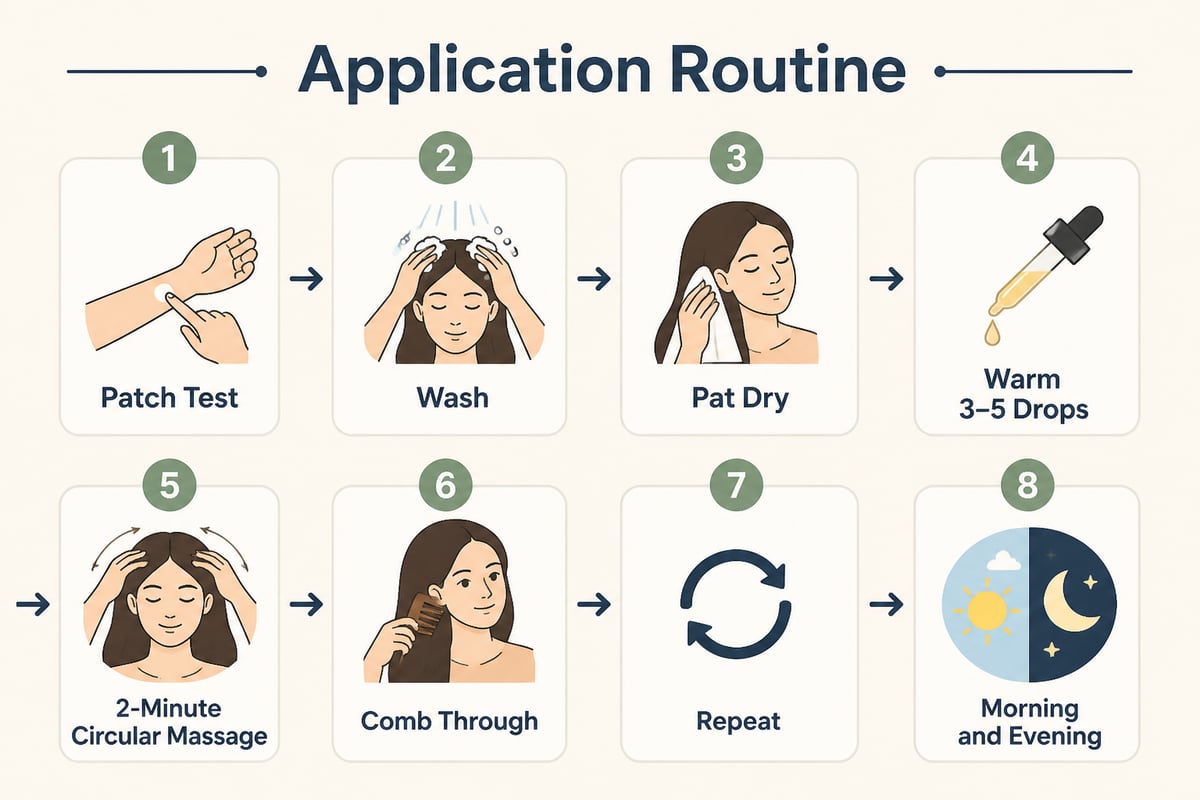
Apply rosemary beard oil to clean, slightly damp skin, use a few drops, and massage it down to the skin rather than just the hair. Technique matters as much as the ingredient.
- Patch test first. Dab a small amount on your inner forearm and wait 24 hours. Rosemary can irritate sensitive skin, and the scalp trial recorded itching in both groups.
- Wash gently. Use a pH-balanced beard shampoo two to three times a week. Washing every day can strip natural oils, which may leave your skin dry.
- Pat dry. Leave the beard slightly damp so the oil spreads easily and traps moisture.
- Warm three to five drops in your palms. Longer beards need more, but start small.
- Massage for two minutes. Use firm, circular motions from the cheekbones down to the neck. The massage itself increases blood flow, which is half the point.
- Comb through. A wide-tooth comb spreads the oil to the tips and detangles without snapping hair.
- Repeat once or twice daily. Morning and evening works well, and consistency beats quantity.
Keep trimming hygienic too. The American Academy of Dermatology recommends changing a razor blade every 5 to 7 shaves to help prevent irritation when you tidy your neckline or cheek line.
Can You Put Rosemary Oil Directly on Skin or Hair?
No, you should not apply undiluted rosemary essential oil directly to skin or hair. Essential oils are highly concentrated plant extracts, and raw rosemary can cause redness, burning and contact dermatitis.
Dilute it in a carrier oil before it touches your face. A common guideline is one to two per cent, which works out to roughly six to twelve drops of essential oil per 30 ml of carrier. Jojoba suits beards well because its structure resembles human sebum, so many people find it absorbs without turning greasy. Argan and sweet almond oil also work.
Pre-blended products remove the guesswork. A formulated rosemary beard oil already sits at a safe concentration, and it carries the carrier oils that deliver the benefit to your skin.
What to Look for in a Rosemary Beard Oil
Look for a short ingredient list that names the carrier oils and the rosemary source, rather than a vague "fragrance" or "essential oil blend".
- Named carrier oils such as jojoba or argan, which moisturise without clogging pores.
- True rosemary (Rosmarinus officinalis), not synthetic scent.
- Natural formulation, since added alcohol and synthetic perfume dry the skin and defeat the purpose.
- A dropper or pump bottle, which controls dose and limits air exposure that degrades plant oils.
- A refund policy, because the evidence points to a three to six month wait.
For a scented option that fits the same logic, Onesociety's beard oil collection covers everything from black pepper and lavender to bay rum.
FAQ
Is rosemary essential oil good for beard growth?
It may help, though the proof is indirect. The best human evidence comes from a six-month scalp trial in which rosemary oil and 2% minoxidil produced no significant difference in hair count. Nobody has run an equivalent facial trial, so treat it as a promising support, not a guarantee.
How long does rosemary oil take to show results on a beard?
Plan for at least three months, and expect clearer results nearer six. The scalp trial found no significant change at three months and a significant increase at six. Take a photo each month in the same light to track progress objectively.
Can rosemary beard oil cause irritation?
Yes, in some people. Rosemary can trigger redness or itching, especially undiluted or on sensitive skin. Patch test first, use a pre-diluted formula, and stop if burning or a rash develops.
Start tonight with a patch test: dab a diluted rosemary beard oil on your inner forearm, check it tomorrow, then photograph your beard so you can measure real change at the three-month mark. When you are ready to commit to a full routine rather than a single bottle, the 90-Day Beard Challenge gives you eight coordinated formulas and a refund guarantee, so you can test the approach with very little risk.