

Your beard deserves precision engineering, not guesswork. Every man who's experienced tugging, uneven cuts, or skin irritation knows the frustration of substandard trimming tools. Professional beard clippers represent the difference between a polished, intentional appearance and a grooming disaster that takes weeks to rectify.
The science behind effective beard trimming centres on blade geometry and motor torque. When blades lack proper alignment, they pull rather than cut, damaging follicles at the root. This mechanical stress triggers inflammatory responses in surrounding dermal tissue, leading to ingrown hairs and folliculitis. Professional-grade equipment eliminates this problem through precision manufacturing tolerances measured in microns.
Understanding Professional-Grade Clipper Technology
The distinction between consumer and professional beard clippers lies in engineering fundamentals. Motor design determines cutting consistency across varying hair densities and textures.
Motor Types and Torque Delivery
Three primary motor configurations dominate the professional market:
- Rotary motors: Generate consistent torque at lower speeds, ideal for thick, coarse beards
- Pivot motors: Deliver rapid blade oscillation, cutting up to 7,200 strokes per minute
- Magnetic motors: Provide linear cutting motion with minimal heat generation
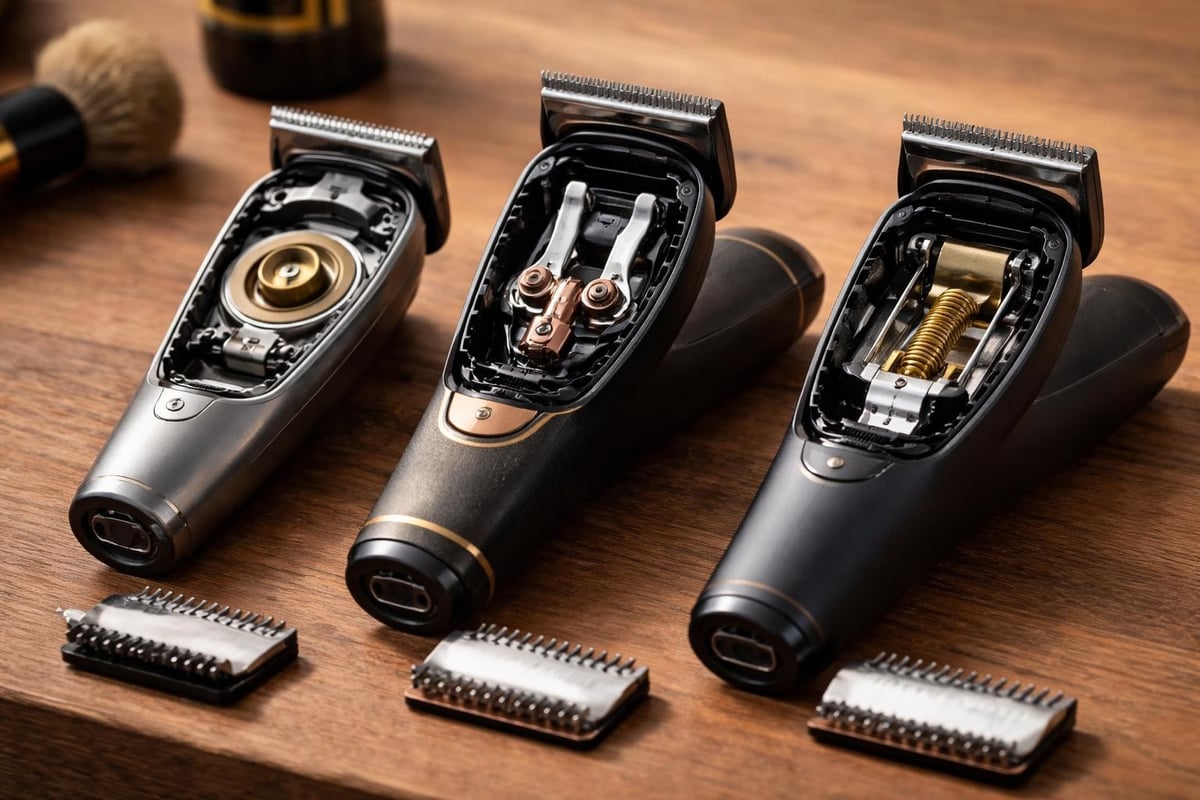
Rotary motors function through electromagnetic induction, converting electrical energy into mechanical rotation. The constant torque curve prevents stalling when encountering dense growth patterns. According to Alibaba's professional clipper guide, this consistency enables barbers to maintain uniform cutting speed regardless of hair thickness.
Pivot motors excel in precision work. The rapid oscillation creates a scissor-like cutting action that slices rather than tears hair shafts. This biomechanical advantage reduces split ends and maintains the natural protein structure of each strand.
Blade Metallurgy and Edge Retention
Professional beard clippers utilise specific alloy compositions engineered for durability. Carbon steel blades maintain sharp edges through repeated use, whilst titanium-coated variants reduce friction coefficient by 40%.
| Blade Material | Hardness (HRC) | Edge Retention | Corrosion Resistance |
|---|---|---|---|
| Carbon Steel | 58-62 | Excellent | Moderate |
| Stainless Steel | 52-56 | Good | Excellent |
| Titanium-Coated | 60-64 | Superior | Excellent |
| Ceramic | 85-90 | Outstanding | Superior |
The Rockwell hardness scale (HRC) quantifies a material's resistance to deformation. Higher values correlate with extended intervals between sharpening sessions. Ceramic blades achieve exceptional hardness but require careful handling due to brittleness under impact stress.
Chrome plating serves a dual function: it creates a chemically inert surface that resists oxidation whilst reducing adhesive friction. This coating allows hair to slide along the blade surface rather than binding, which extends motor lifespan by reducing mechanical load.
Selecting Clippers for Specific Beard Types
Your beard's unique characteristics determine which professional beard clippers deliver optimal results. Coarse, wiry beards demand different specifications than fine, straight growth patterns.
Coarse and Dense Beard Requirements
Men with thick facial hair require robust cutting systems. The hair shaft diameter in coarse beards measures 80-120 micrometres, compared to 40-60 micrometres in fine beards. This structural difference necessitates higher torque delivery.
Professional barbers recommend clippers with minimum motor output of 15 watts for dense beards. Research into professional barbering tools demonstrates that underpowered motors create excessive heat during prolonged use, degrading cutting performance.
The blade gap setting controls how hair enters the cutting chamber. For coarse beards, a gap of 0.8-1.2mm prevents jamming whilst maintaining clean cuts. Adjustable tension springs allow real-time modification based on growth density in different facial zones.
Fine and Straight Beard Specifications
Fine beards present opposite challenges. Excessive blade gaps allow hair to slip through uncaptured, creating patchy results. Professional beard clippers designed for this texture feature zero-overlap blade configurations.
Zero-overlap design positions the top blade slightly forward of the bottom blade, eliminating dead space. This geometry captures every hair shaft, regardless of diameter. The cutting action relies on shearing force rather than mechanical trapping.
Heat dissipation becomes critical in extended grooming sessions. Aluminium alloy housings conduct thermal energy away from blade assemblies 3.5 times faster than plastic alternatives. This prevents blade expansion, which compromises cutting tolerances.
Ergonomic Design and Handling Characteristics
Precision control requires ergonomic excellence. Professional beard clippers that cause hand fatigue compromise accuracy after 10-15 minutes of continuous use.
Weight Distribution and Balance Points
The centre of gravity position influences control during detailed work. Clippers balanced near the blade assembly enable finer movements, essential for defining cheek lines and necklines.
Optimal weight ranges between 175-225 grams for corded models. This mass provides sufficient feedback for spatial awareness without creating fatigue. Battery-powered variants add 40-60 grams, shifting the balance point rearward.
Grip texture affects control under various conditions. Rubberised coatings with durometer hardness of 30-40 Shore A provide tactile feedback whilst maintaining cleanliness. Harder compounds reduce grip when hands become damp from washing or product application.
Vibration Dampening Systems
Motor oscillation transfers vibrations through the housing. Prolonged exposure causes hand-arm vibration syndrome, characterised by reduced sensation and grip strength. Professional clipper selection guides emphasise isolation mounting systems that reduce transmitted vibration by 60-75%.
Internal dampening relies on elastomeric buffers positioned between motor assemblies and outer housings. These polymers absorb high-frequency vibrations before they reach your hand. Silicon-based compounds outperform natural rubber in temperature stability and compression set resistance.

Maintenance Protocols for Longevity
Professional beard clippers require systematic maintenance to preserve cutting performance. Neglected equipment degrades rapidly, losing precision within 50-75 operating hours.
Blade Cleaning and Lubrication
Hair fragments and skin cells accumulate between blade teeth, creating bacterial growth environments. Daily cleaning with isopropyl alcohol (70% concentration minimum) dissolves organic residues whilst evaporating completely.
The lubrication schedule depends on usage frequency:
- Light oil application: After every 3-4 uses (30-40 minutes total runtime)
- Deep cleaning with solvent: Weekly for daily users
- Blade alignment check: Monthly or after 20 hours of operation
- Complete disassembly and inspection: Quarterly
Clipper oil viscosity specifications typically range from ISO VG 10-15. This low viscosity ensures complete penetration between moving surfaces whilst preventing buildup. Synthetic formulations resist oxidation better than petroleum-based alternatives, extending service intervals.
Motor Housing Ventilation
Air intake ports require monthly inspection and cleaning. Accumulated debris restricts airflow, forcing motors to operate at elevated temperatures. Thermal stress accelerates winding insulation degradation, reducing operational lifespan by 40%.
Compressed air at 30-40 PSI effectively clears intake vents without damaging internal components. Direct the airflow opposite to normal intake direction to expel particles completely. Avoid vacuum cleaners, which can generate static electricity that damages electronic speed controllers.
Professional Features That Matter
Advanced functionality separates professional beard clippers from basic consumer models. These features address specific grooming challenges that arise during detailed beard sculpting.
Adjustable Blade Systems
Taper levers modify cutting length without changing guard attachments. This mechanical adjustment tilts the top blade, altering the gap between cutting surfaces. Professional models offer 5-8 distinct positions, providing length variations of 0.2-0.4mm per click.
The biological advantage lies in gradual transitions. When creating fade effects along the jawline, abrupt length changes create visible demarcation lines. Incremental adjustments blend naturally with existing growth patterns, mimicking the gradual density reduction of a healthy beard's perimeter.
Detachable blade assemblies enable quick switches between cutting widths. Standard blades measure 40-45mm, whilst detail blades narrow to 20-25mm for precision edging. Expert reviews from T3 highlight this versatility as essential for comprehensive grooming without multiple tools.
Cord and Cordless Considerations
Power delivery methods impact performance characteristics significantly. Corded professional beard clippers maintain constant power output regardless of duration. The electrical supply provides unlimited runtime, critical for extensive grooming sessions or multiple users.
Battery technology has advanced substantially. Lithium-ion cells deliver 90-120 minutes of operation from a 90-minute charge. These power sources maintain voltage stability until depletion, preventing the gradual performance degradation characteristic of older nickel-cadmium batteries.
| Power Type | Runtime | Power Consistency | Weight | Portability |
|---|---|---|---|---|
| Corded | Unlimited | 100% constant | 175-200g | Limited |
| Lithium-Ion | 90-120 min | 95% until depletion | 225-280g | Excellent |
| Dual (Cord/Cordless) | Variable | 100% corded / 95% battery | 240-300g | High |
The charging circuit design affects battery longevity. Smart charging systems that prevent overcharging extend cell lifespan to 800-1,000 charge cycles. Basic designs without thermal monitoring degrade batteries 50% faster through heat accumulation during charging.
Integration with Complete Grooming Systems
Professional beard clippers function as part of a comprehensive maintenance routine. Cutting represents only one aspect of optimal beard health. Proper nutrition of hair follicles and skin conditioning create the foundation for grooming excellence.
Quality products formulated with scientifically-proven ingredients support the grooming results you achieve with professional equipment. Natural oils containing linoleic acid penetrate the hair shaft, improving elasticity and reducing brittleness. This biochemical reinforcement makes beards more responsive to trimming, with less resistance against blade edges.
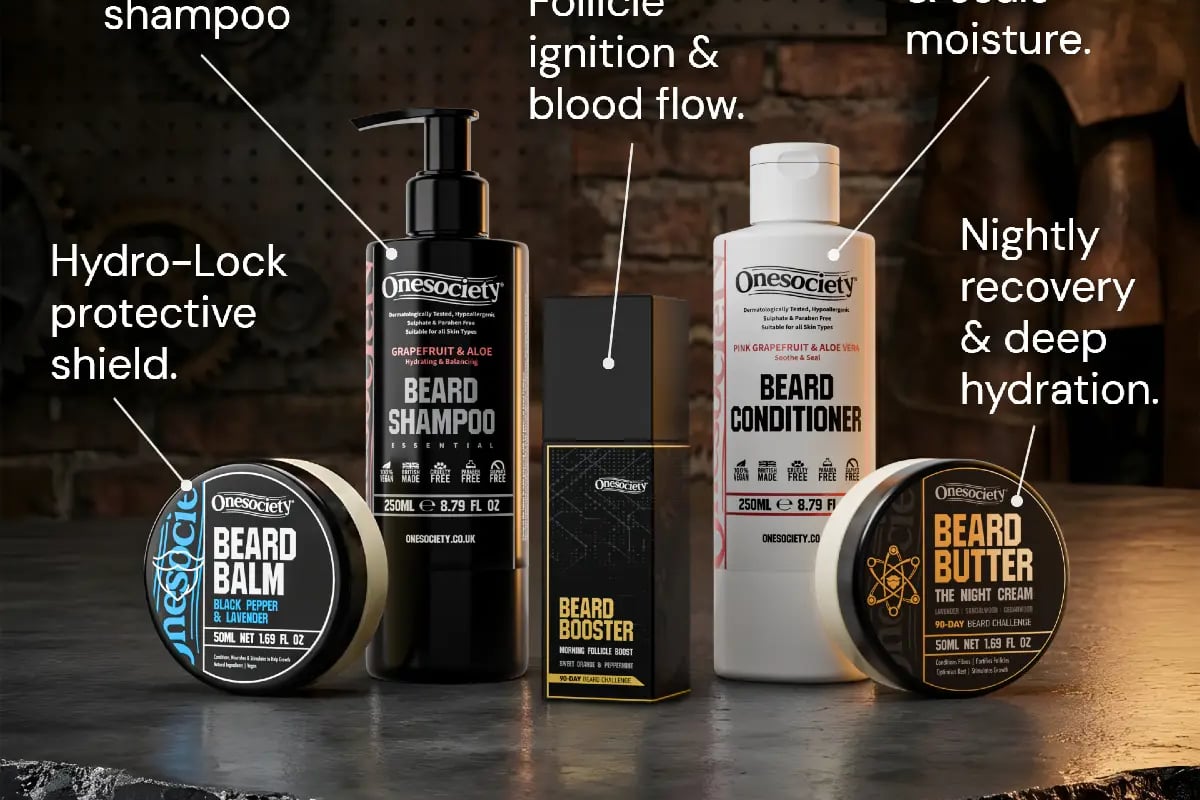
The 90-Day Beard Challenge provides a systematic approach to beard development through targeted formulations. The Beard Booster increases blood flow to follicles through vasodilatory compounds, whilst the Hydro-Lock Balm creates a protective lipid barrier that retains moisture. This combination ensures your professionally-trimmed beard maintains shape and texture between grooming sessions.

Guard Attachments and Length Control
Precise length management requires comprehensive guard systems. Professional beard clippers include 8-12 attachment combs spanning 1.5-25mm lengths.
Guard Construction and Durability
Material composition determines guard lifespan and accuracy. Injection-moulded polycarbonate maintains dimensional stability under thermal stress. Cheaper ABS plastic warps after 6-12 months of regular use, creating inconsistent cutting lengths.
The attachment mechanism must provide secure mounting without excessive play. Magnetic coupling systems eliminate wobble whilst enabling single-handed removal. Traditional clip designs wear over time, allowing movement during cutting that creates uneven results.
Internal teeth spacing affects hair flow into the blade assembly. Guards with 1.0-1.5mm tooth spacing prevent hair from bending away from blades, particularly important for softer beard textures that compress easily.
Creating Gradient Effects
Achieving professional fade effects requires strategic guard progression. The biological principle involves mimicking natural growth density variations. Beards naturally grow thicker along the jawline, gradually thinning toward the cheeks and neck.
Professional technique employs the "thirds rule":
- Lower third (neck to jaw): Shortest length, typically 3-6mm
- Middle third (jaw to cheekbone): Intermediate length, 9-12mm
- Upper third (cheekbone to cheek line): Full length, 15-20mm
Transitional zones between these sections require careful blending. Use guards in 1-2mm increments, overlapping each pass by 40-50%. This creates gradual transitions invisible to casual observation.
Noise Reduction Technology
Acoustic output affects user experience significantly. Professional beard clippers operating above 75 decibels cause listening fatigue during extended use.
Sound Dampening Mechanisms
Motor encapsulation with acoustic foam reduces high-frequency noise by 15-20 decibels. The cellular structure of these materials absorbs sound waves through conversion to minor heat energy. Closed-cell foams prevent moisture absorption, maintaining acoustic properties despite humidity exposure.
Bearing quality influences operational noise substantially. Ceramic ball bearings reduce friction-induced sound whilst extending service life. Steel bearings require higher tolerances to achieve comparable quietness but cost 40% less.
Temperature Management During Use
Blade assemblies generate significant thermal energy during operation. Professional beard clippers must dissipate this heat to prevent skin contact discomfort and maintain cutting efficiency.
Thermal Design Principles
Heat transfer occurs through three mechanisms: conduction, convection, and radiation. Professional clippers maximise all three pathways. Aluminium blade housings conduct heat rapidly to the outer casing, where air movement removes thermal energy through convection.
Ventilation channels within the housing create directed airflow across motor windings. This forced convection removes heat 5-7 times faster than passive air movement. The intake positioning determines cooling effectiveness. Bottom-mounted intakes draw cool ambient air, whilst side intakes can recirculate pre-heated air.
Blade temperatures above 45°C trigger thermal discomfort receptors in facial skin. Continuous-duty professional beard clippers maintain blade temperatures below 40°C through active cooling strategies. Analysis of professional equipment confirms that thermal management directly correlates with cutting consistency.
Precision Edging Capabilities
Creating defined lines requires specialised blade configurations. Professional beard clippers incorporate multiple cutting head options for various detailing tasks.
T-Blade and Detail Trimmer Functions
T-shaped blade assemblies measure 25-32mm wide with squared corners. This geometry enables precise line work along cheek lines and necklines. The narrow profile provides unobstructed visibility, critical for symmetrical results.
Zero-gap adjustment on detail blades allows cutting to 0.1mm length. This creates crisp definition whilst avoiding complete hair removal. The biological benefit lies in maintaining follicle health. Complete shaving triggers pseudofolliculitis barbae in susceptible individuals, whilst minimal-length trimming prevents this inflammatory response.
Detail work demands steady hand control. Lightweight trimmer designs (80-120g) reduce fatigue during extended edging sessions. The reduced mass enables finer motor control, essential for creating curved lines that follow natural facial contours.
Investment Value and Cost Analysis
Professional beard clippers represent significant initial expenditure compared to consumer alternatives. Understanding the total cost of ownership requires examining durability, performance consistency, and replacement intervals.
Lifespan Economics
Consumer-grade clippers typically survive 200-400 hours of operation before motor failure or blade degradation necessitates replacement. Professional models engineered for commercial use withstand 2,000-5,000 hours through superior component quality.
The hourly cost calculation reveals the economic advantage:
- Consumer clipper: £40 purchase ÷ 300 hours = £0.13/hour
- Professional clipper: £120 purchase ÷ 3,000 hours = £0.04/hour
This analysis excludes performance degradation. Consumer models lose cutting efficiency after 100-150 hours, whilst professional beard clippers maintain consistent performance throughout their service life. The value proposition extends beyond pure economics to encompass grooming quality and skin health.
Blade replacement costs vary significantly. Professional blades range from £15-35 but maintain sharpness for 500-800 hours. Consumer replacement blades cost £8-15 yet require changing every 150-200 hours.
Selecting Between Major Brands
The professional clipper market features established manufacturers with distinct engineering philosophies. Understanding these differences enables informed selection based on specific requirements.
Performance Differentiation
German engineering emphasises precision manufacturing and component longevity. These professional beard clippers command premium pricing but deliver exceptional build quality. Tolerances maintained within 0.05mm ensure blade alignment remains stable across years of operation.
American manufacturers prioritise power delivery and versatility. Higher wattage motors handle diverse beard types without specification changes. Insights from professional barbers reveal preferences based on clientele demographics and predominant beard textures.
Asian production focuses on cost-performance optimisation. These brands deliver 80-85% of premium performance at 50-60% of the price. The compromise involves reduced longevity and less refined ergonomics rather than fundamental capability gaps.
Hygiene Standards for Shared Equipment
Professional environments require stringent sanitation protocols. Beard clippers used across multiple individuals demand disinfection that exceeds basic cleaning.
Sterilisation Procedures
Effective pathogen elimination requires multi-stage processing:
- Physical debris removal: Brush away visible hair and skin cells
- Chemical disinfection: Immerse blades in quaternary ammonium solution (10 minutes)
- Alcohol wipe-down: 70% isopropyl alcohol on all surfaces
- UV-C exposure: 15-minute cycle in sterilisation cabinet (optional)
Quaternary ammonium compounds disrupt bacterial cell membranes through surfactant action. This mechanism provides broad-spectrum efficacy against bacteria, fungi, and enveloped viruses. The 10-minute contact time ensures complete pathogen inactivation.
UV-C radiation at 254nm wavelength damages microbial DNA, preventing replication. Professional cabinets deliver 30-40 milliwatts per square centimetre, sufficient for hospital-grade sterilisation. This non-chemical method eliminates concerns about residue or corrosion.
Adapting Technique for Different Facial Zones
Facial topography varies substantially across regions. Professional beard clippers must accommodate these structural differences through technique modification.
Cheek Line Precision
The cheek line defines upper beard boundaries. Creating symmetrical lines requires reference points based on facial anatomy. Professional technique uses the tragus (ear cartilage projection) as the starting reference.
Hold professional beard clippers perpendicular to the skin surface, moving in short 2-3cm strokes. The biological rationale involves hair growth direction. Facial hair on the cheeks grows at varying angles, typically 30-50 degrees from vertical. Perpendicular blade positioning cuts all hairs regardless of growth angle.
Skin tension affects cutting accuracy significantly. Stretching the cheek skin with your free hand creates a flat cutting surface, eliminating contour-induced gaps. This technique reduces required passes, minimising follicle stress and skin irritation.
Neckline Architecture
The neckline represents the most visible aspect of beard grooming from frontal views. Proper placement requires anatomical landmarks. Professional standards position the line one finger-width above the Adam's apple, curving upward toward the ear.
Growth patterns on the neck often reverse direction below the jawline. This requires blade movement adjustments to prevent tugging. Professional beard clippers handle bidirectional cutting through reversible blade orientations or omnidirectional cutting geometries.
Mastering professional beard clippers transforms your grooming routine from haphazard maintenance to precision styling. The investment in quality equipment pays dividends through consistent results, reduced skin irritation, and extended intervals between replacements. Your beard represents a significant commitment to personal appearance, deserving tools engineered for excellence. Onesociety complements your technical grooming skills with scientifically-formulated beard care products that nourish follicles and maintain optimal beard health between trimming sessions. Explore the complete range to discover how natural ingredients backed by research elevate your grooming results beyond what equipment alone can achieve.