

Every beardsman faces the same frustrating reality: you've invested weeks building your facial hair, only to watch a single clumsy trim destroy months of growth. That uneven patch near your jawline haunts you for weeks. Your cheek lines wander like a confused tourist. The neck stubble refuses to blend. You've tried basic clippers, watched countless YouTube tutorials, yet your beard still looks more "accidental hermit" than "intentional style statement." The manscaped beard hedger entered this overcrowded market with bold promises about precision trimming, but does it actually solve these persistent problems, or simply add another gadget to your bathroom drawer?
The Precision Problem Most Beard Trimmers Create
Standard beard trimmers cut hair, certainly. They remove length. They reduce volume. Yet they struggle with the nuanced work that transforms facial hair from "present" to "polished."
The issue stems from blade width and guard flexibility. Traditional clippers feature wide cutting paths designed for efficiency across large scalp areas. When you apply this same technology to the curved, varied terrain of your face, you sacrifice control. The guards catch on jawbone angles. The width prevents tight corner work around your moustache. The motor speed fluctuates between thick growth and sparse patches, creating uneven results.
Common trimming failures include:
- Asymmetrical sideburn heights that require constant monitoring
- Blurred cheek lines that drift lower with each maintenance session
- Neck definitions that disappear into shadow zones
- Moustache edges that invade lip territory
- Patchy length variations that catch light differently
Yale Medicine's research on facial hair problems confirms that improper trimming techniques compound skin irritation beneath your beard. When you hack away with inadequate tools, you create irregular cutting patterns that pull hairs, inflame follicles, and trigger those maddening ingrown hairs that plague your neck.

How the Manscaped Beard Hedger Addresses Design Flaws
Manscaped built their beard hedger around a different philosophy than traditional clippers. The narrower blade width (typically 25mm versus 32-40mm on standard trimmers) grants access to tighter facial contours. You can navigate the curve from sideburn to jawline without the blade housing obstructing your view or catching on bone structure.
The rotary wheel length adjustment deserves particular attention. Whilst traditional guards snap on and off (disrupting your flow, creating storage hassles, occasionally snapping plastic clips), the manscaped beard hedger integrates a dial system with 20 length settings from 0.5mm to 10mm. You rotate, you cut-no interruption to assess whether you've selected the 3mm or 4mm guard from your collection.
| Feature | Manscaped Beard Hedger | Traditional Clipper |
|---|---|---|
| Blade Width | 25mm (precision focused) | 32-40mm (efficiency focused) |
| Length Settings | 20 incremental (rotary dial) | 4-8 guards (snap-on) |
| Battery Life | 60 minutes cordless | 45-90 minutes (varies) |
| Waterproof Rating | IPX7 (full submersion) | IPX4-5 (splash resistant) |
| Motor Type | Rotary with constant torque | Magnetic or pivot (variable speed) |
The constant torque motor maintains cutting speed regardless of hair density. When you transition from the thick growth beneath your chin to the finer hair on your upper cheek, the blade speed remains identical, preventing the "tug and pull" sensation that signals follicle trauma.
Safety Standards That Actually Matter for Your Face
The IEC safety requirements for household grooming appliances establish baseline expectations for electrical safety, insulation integrity, and mechanical hazard prevention. These standards exist because your face contains substantially more nerve endings, blood vessels, and sensitive tissue than your scalp.
When manufacturers comply with ANSI/UL safety testing protocols, they verify that blade guards prevent direct skin contact, that electrical components resist moisture intrusion (critical during shower use), and that battery cells include thermal runaway protection.
The manscaped beard hedger's IPX7 waterproof certification means the device survives full submersion up to one metre for thirty minutes. This isn't simply about shower convenience-it reflects sealed electrical compartments that prevent short circuits when condensation, shaving foam, or beard oil contacts the housing.
Why Waterproofing Impacts Skin Health
Dermatologists consistently recommend wet trimming for sensitive skin. The American Academy of Dermatology's beard care guidance emphasises hydrating facial hair before trimming to soften the shaft, reducing the cutting force required (and therefore the follicle stress).
When you trim in the shower, steam opens pores and softens both hair and skin. Water carries away cut hairs immediately instead of letting them scatter across your sink, stick to your beard, and subsequently scratch your skin. A waterproof hedger participates in this healthier routine; a splash-resistant one sits on the shelf whilst you revert to dry trimming.
Benefits of wet trimming:
- Hair shafts absorb water and swell, making them easier to cut cleanly
- Steam dilates pores, reducing follicle resistance during cutting
- Immediate hair removal prevents itchy stubble accumulation
- Natural oils remain intact (dry trimming strips them through friction)
- Cleaning becomes effortless-rinse under running water
Creating Professional Lines Without Professional Training
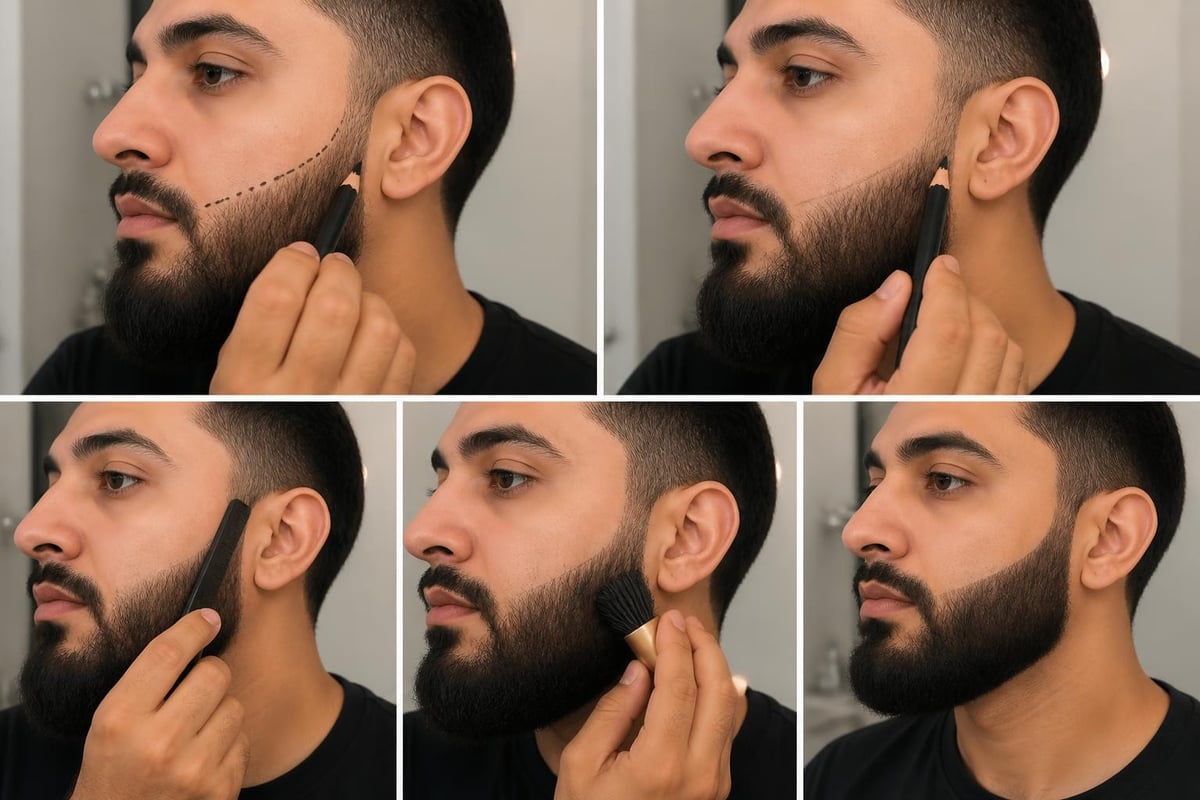
Professional barbers spend years mastering the hand-eye coordination required for symmetrical face work. They understand facial anatomy-where bone structure dictates line placement, how hair growth patterns influence cutting angles, which visual reference points ensure balanced proportions.
You likely lack this training. The manscaped beard hedger attempts to compress this knowledge gap through design features that guide amateur hands toward professional results.
The Rotary Wheel's Hidden Advantage
Length consistency separates amateur trims from barber-quality work. When you change guards mid-session with traditional clippers, you introduce variables: guard seating depth, plastic wear that affects true cutting length, the cognitive load of remembering which guard you used where.
The rotary dial on the manscaped beard hedger maintains mechanical contact with the same blade assembly throughout your entire session. You dial from 7mm on your chin to 4mm on your cheeks to 2mm on your upper cheek line-same blade, same motor, same cutting mechanics. The only variable changes deliberately: the distance between blade edge and skin.
This consistency particularly benefits those challenging transition zones where your beard gradually fades into bare skin. GQ's barber-approved trimming techniques emphasise the "fade" concept-creating imperceptible length graduations that appear natural rather than stepped. With discrete length control, you can execute these fades without the visible "ledges" that snap-on guards create.
| Trimming Zone | Recommended Length | Purpose |
|---|---|---|
| Neck (below jawline) | 0.5-1mm | Clean definition, prevents "neck beard" appearance |
| Jawline transition | 2-3mm | Blends neck into main beard |
| Main beard body | 4-7mm | Primary length (personal preference) |
| Cheek line fade | 3-2-1mm gradient | Softens upper boundary |
| Moustache edge | 2-4mm | Prevents lip coverage whilst maintaining density |
Battery Technology and Maintenance Reality
Cordless convenience collapses when your trimmer dies mid-cheek. The manscaped beard hedger's lithium-ion cell delivers sixty minutes of runtime-sufficient for approximately 15-20 complete grooming sessions between charges.
Battery platform considerations extend beyond simple runtime figures. Cell degradation patterns determine whether your sixty-minute battery maintains this capacity after twelve months or deteriorates to thirty minutes. Charge cycle ratings (typically 300-500 full cycles for quality lithium-ion cells) indicate usable lifespan before replacement becomes necessary.
The USB-C charging standard offers practical advantages over proprietary connectors. You likely own multiple USB-C cables for phones, tablets, and other devices. When you travel, you pack one cable type instead of hunting for that specific trimmer charger. When the original cable fails (as all cables eventually do), replacement costs £5 instead of £25 for a manufacturer-specific part.
Cleaning Protocols That Extend Blade Life
Men's Health's maintenance recommendations emphasise three critical practices: immediate post-use rinsing, weekly oil application, and monthly deep cleaning.
The manscaped beard hedger's full waterproof rating simplifies the first requirement. Hold the running trimmer under warm tap water for fifteen seconds. Hair fragments, skin cells, and product residue wash away instead of accumulating in blade teeth and motor vents.
Weekly maintenance checklist:
- Rinse thoroughly under running water
- Shake excess water from housing
- Apply 2-3 drops of clipper oil across blade width
- Run trimmer for 10 seconds to distribute oil
- Wipe housing with microfibre cloth
Oil serves two functions. First, it prevents oxidation (rust) on carbon steel blades exposed to moisture. Second, it reduces friction between moving blade components, decreasing wear and heat generation. A properly oiled blade cuts cooler and sharper.
The Natural Grooming Ecosystem
Precision trimming establishes your beard's architecture-the shape, the boundaries, the length proportions. Yet trimming alone doesn't address the biological health of your facial hair and the skin beneath it.
Your beard requires the same foundational care as the hair on your scalp: cleansing to remove accumulated sebum and environmental debris, conditioning to restore moisture lost during washing, and protective products that seal the hair cuticle against daily damage.
Many beardsmen focus exclusively on trimming tools whilst neglecting the condition of what they're trimming. Dry, brittle facial hair breaks rather than cuts cleanly. Inflamed follicles grow irregular hair shafts that resist uniform trimming. Dehydrated skin produces flakes that scatter when you trim, creating that persistent "beard dandruff" that undermines even the sharpest lines.
The 90-Day Beard Challenge from Onesociety addresses this complete care spectrum. The kit includes follicle-stimulating formulas that improve growth density, hydrating treatments that prepare hair for cleaner cuts, and protective balms that seal your freshly trimmed edges against moisture loss.

When you pair precision trimming tools like the manscaped beard hedger with science-backed grooming products, you create a comprehensive system: the hedger establishes your shape, whilst targeted formulas optimise the health and appearance of every hair within that shape.
Preventing Trimming-Related Skin Problems
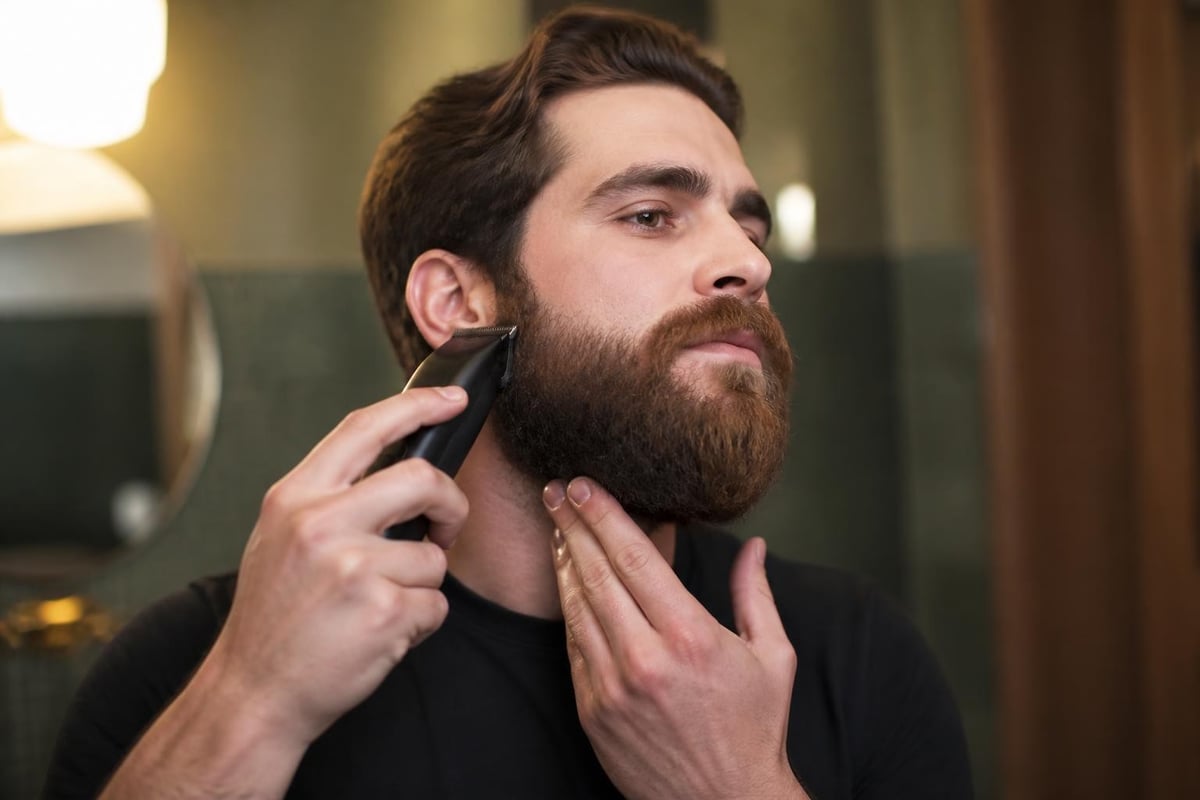
The American Academy of Dermatology's guidance on preventing razor bumps applies equally to trimming-induced irritation. When you cut hair too short (particularly on your neck), the sharp cut end can curl back and penetrate the skin as it grows, creating those inflamed bumps that itch and occasionally become infected.
The manscaped beard hedger's adjustable length settings let you maintain slightly longer neck hair (1-2mm instead of complete bare skin) that reduces ingrown hair risk whilst still providing clean definition. This "guard against the grain" approach balances aesthetic preferences with dermatological wisdom.
Irritation prevention strategies:
- Never trim completely dry skin (hydrate first with warm water)
- Move trimmer in the direction of hair growth (with the grain) for sensitive areas
- Maintain minimum 1mm length on neck zones prone to ingrown hairs
- Apply alcohol-free aftershave balm immediately post-trim
- Clean your trimmer between sessions to prevent bacterial transfer
Evaluating Value Beyond Initial Purchase Price
The manscaped beard hedger typically retails between £60-£80 depending on sales and regional pricing. This positions it in the mid-premium category-substantially above £20 supermarket clippers, notably below £150+ professional barber tools.
Value calculations extend beyond the purchase transaction. Factor in replacement blade costs (every 12-18 months for maintained blades), battery replacement feasibility (some devices seal batteries permanently), and the opportunity cost of poor results (barber visits to fix DIY disasters).
Total cost of ownership considerations:
| Expense Category | Manscaped Beard Hedger | Budget Clipper | Barber Visits |
|---|---|---|---|
| Initial Purchase | £70 | £25 | £0 |
| Annual Maintenance | £15 (oil, cleaning) | £10 | £0 |
| Replacement Parts (2 years) | £25 (blade assembly) | £0 (replace entire unit) | £0 |
| Professional Corrections | £0-£30 (skill dependent) | £60-£120 (frequent fixes) | £480 (£20 × 24 visits) |
| Two-Year Total | £110-£140 | £95-£215 | £480 |
The calculation reveals two insights. First, quality tools reduce correction costs-you spend less fixing mistakes because you make fewer mistakes. Second, even moderate DIY success delivers substantial savings versus professional maintenance schedules.
Practical Application: Building Your Trimming Routine
Theory dissolves when you stand before the mirror with a half-trimmed beard and dawning panic. Practical routines convert knowledge into consistent results.
The systematic approach:
-
Pre-trim preparation (3 minutes)
- Wash beard with warm water or trim post-shower
- Comb through completely to remove tangles and establish natural lay
- Dry 80% (slightly damp hair cuts more cleanly than soaking wet)
-
Establish primary length (5 minutes)
- Set manscaped beard hedger to desired main length
- Work with hair growth direction across entire beard
- Use consistent, overlapping strokes (don't skip randomly)
-
Define cheek lines (4 minutes)
- Reduce length by 2-3mm from main setting
- Identify natural curve from sideburn to moustache corner
- Create initial pass along this line
- Blend downward into main beard with intermediate length
-
Shape neck boundary (3 minutes)
- Locate Adam's apple and measure two fingers width above
- Create horizontal line connecting points behind jawbone
- Remove everything below this line at 0.5-1mm
- Blend upward into jawline beard
-
Refine moustache and details (3 minutes)
- Trim moustache edges to prevent lip coverage
- Address any stray long hairs in main beard
- Check symmetry and adjust discrepancies
For comprehensive guidance on integrating trimming into your complete grooming routine, Onesociety's personal care approach emphasises the connection between mechanical maintenance (trimming) and biological support (nourishment).
Alternative Approaches and Competitive Context
The manscaped beard hedger competes in a crowded landscape of facial hair tools. Philips offers the OneBlade hybrid razor-trimmer. Wahl produces professional-grade corded clippers. Braun markets precision trimmers with multiple head attachments.
Each approach prioritises different variables. The OneBlade emphasises skin-level cutting for defined edges but lacks length versatility. Wahl's corded power delivers consistent performance but eliminates cordless freedom. Braun's attachment variety handles multiple grooming tasks but increases complexity.
Comparison across priorities:
- Maximum versatility: Multi-attachment systems (Braun, Philips Multigroom)
- Longest battery life: Premium models with 90+ minute runtime
- Finest detail work: Precision trimmers with sub-1mm capabilities
- Budget efficiency: Basic single-guard clippers under £30
- Shower convenience: Fully waterproof designs (manscaped beard hedger, Philips AquaTouch)
The manscaped beard hedger occupies the "focused execution" category. It performs beard trimming comprehensively without attempting to also edge your hairline, detail your eyebrows, and trim your body hair. This specialisation reduces the learning curve-fewer attachments to understand, fewer mode selections to master, fewer ways to accidentally select the wrong setting and scalp your moustache.
Long-Term Beard Development Strategy
Your beard evolves across months and years. The patchy growth at week three transforms into respectable coverage by week twelve. The wiry texture of month two softens with proper conditioning by month six. Your trimming approach must adapt to these biological changes.
Early growth phases (weeks 1-8) require minimal trimming. You're establishing density and identifying your natural growth pattern. Aggressive shaping during this phase removes the foundational length you'll later need for styling options.
The manscaped beard hedger's length range accommodates this progression. Start with longer settings (7-10mm) during establishment phases, gradually reducing to your preferred maintenance length (typically 4-6mm) once you've achieved adequate density and identified your optimal shape.
Growth phase trimming guidelines:
| Phase | Duration | Trimming Frequency | Focus Areas |
|---|---|---|---|
| Initial Growth | Weeks 1-4 | None | Let it grow, resist temptation |
| Pattern Emergence | Weeks 5-8 | Every 2 weeks | Neck line only, establish boundaries |
| Shape Definition | Weeks 9-16 | Weekly | Add cheek lines, begin length control |
| Maintenance | Month 5+ | Every 3-5 days | Consistent shape refinement |
When you commit to comprehensive beard development, you're investing in a months-long transformation. The foundation of quality grooming products supports this journey at the biological level-stimulating follicles, nourishing hair shafts, and maintaining skin health beneath your developing facial hair.
Troubleshooting Common Hedger Challenges
Even quality tools present learning curves. The manscaped beard hedger requires technique refinement to achieve its promised precision.
Challenge: Uneven cutting results despite consistent strokes
Cause: Hair lies in multiple directions across your face. Cutting with the grain in one area means cutting against the grain in another.
Solution: Map your growth patterns when your beard reaches 5mm+ length. Wet your beard and comb it-the natural lie reveals your grain direction. Divide your face into zones (chin grows down, neck grows up, cheeks grow forward-down) and adjust stroke direction per zone.
Challenge: Battery dies faster than advertised sixty minutes
Cause: Lithium-ion cells degrade with age and charge cycles. Extreme temperatures accelerate degradation.
Solution: Avoid leaving the trimmer in cold garages or hot cars. Charge before the battery fully depletes (partial charging extends cell lifespan). If runtime drops below thirty minutes after 18+ months, consider battery replacement or unit upgrade.
Challenge: Blades pull hair rather than cutting cleanly
Cause: Insufficient lubrication creates friction, or accumulated debris dulls cutting edges.
Solution: Implement the weekly oil protocol religiously. If pulling persists after oiling, remove any accessible blade components and clean with a stiff brush. Extremely dull blades (after 18+ months) require replacement regardless of maintenance quality.
Challenge: Difficulty achieving symmetrical cheek lines
Cause: Facial asymmetry (everyone has it) and lack of visual reference points.
Solution: Identify a consistent anatomical landmark-typically the cheekbone's highest point. Measure the vertical distance from this point to your proposed cheek line. Apply this same measurement on both sides. Use your nose centre as a vertical reference line for horizontal alignment checks.
The Precision Trimming Mindset
Tools enable results, but mindset determines consistency. Professional barbers approach every client with systematic methodology-assessment, planning, execution, refinement. You can adopt this same framework for DIY grooming.
Assessment: Examine your current beard state before touching the trimmer. Where has length become uneven? Which boundaries need redefinition? What specific outcome do you want from this session?
Planning: Select your length settings before you begin. Identify the sequence-will you establish overall length first or define boundaries? Which areas demand greatest attention?
Execution: Work methodically through your planned sequence. Resist the urge to jump randomly around your face "fixing" perceived problems-this path leads to over-trimming and asymmetry.
Refinement: Step back, assess the results, make targeted corrections. Small adjustments outperform wholesale changes.
The manscaped beard hedger rewards this disciplined approach. Its adjustment wheel tempts impulsive length changes mid-session, but systematic work produces superior outcomes to reactive "fix it as I go" strategies.
Precision beard trimming transforms facial hair from accidental growth into intentional style. The manscaped beard hedger delivers the mechanical capabilities-adjustable length control, waterproof versatility, consistent cutting power-that enable this transformation. Yet tools alone don't create legendary beards. You need the biological foundation of healthy follicles, properly nourished hair shafts, and conditioned skin. Onesociety combines scientifically formulated natural products with the education and support to build that foundation, creating the complete ecosystem where precision trimming achieves its full potential.